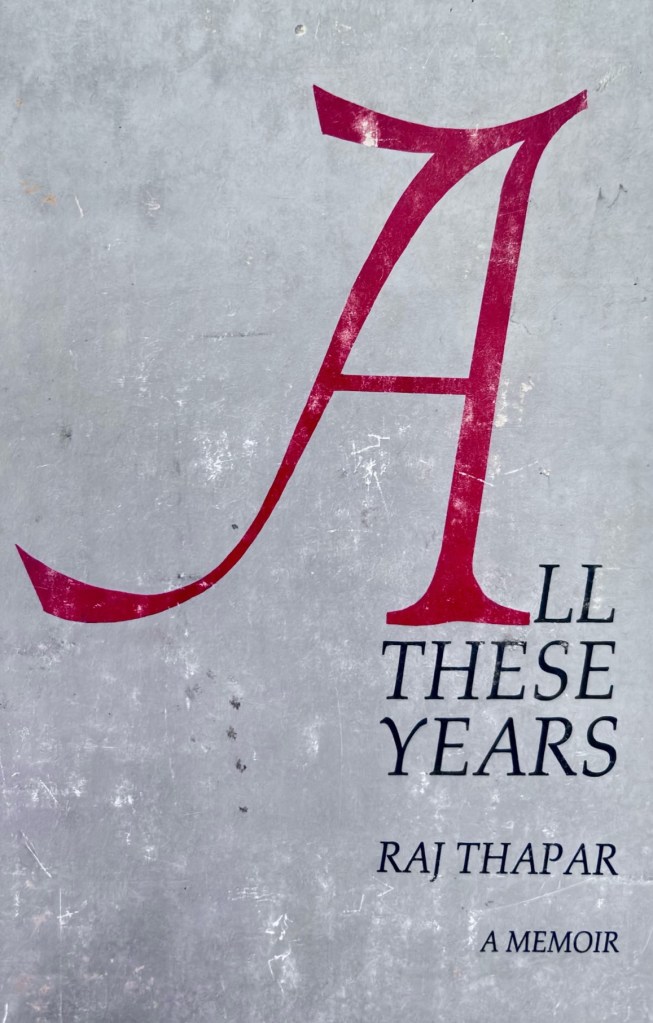
We sometimes find strange things about strange people in strange places, like I found Karimuddin Asif (a tailor who became a film director) in Raj Thapar’s memoir — All These Years — that was given to me by her daughter Mala Singh nearly 35 years ago.
“Your first lesson in politics,” Mala wrote on the first blank page of the book, which I got around reading again recently after three decades!
Amidst the politics spanning five decades I found Asif lying “in his bath tub atop blocks of ice, his method of cooling down for sleep” whenever he felt overwhelmed with the heat and tension of directing the glorious Mughal-e-Azam, starring Prithviraj Kapoor, Dilip Kumar and Madhubala, which took 16 years to make!
So what is Asif — who died young after making what was then biggest blockbuster of its times — doing in Raj’s memoir? He got in there because of her husband Romesh — at one point a close advisor of Indira Gandhi — who was tasked during his days in what was then Bombay to write the English script of the film for a then princely monthly fee of 700 rupees. Asif wanted an English version of the film. It didn’t happen.
Mughal-e-Azam almost ruined the financier Shapoorji Pallonji Mistry (more about him another time), but became a huge success once it hit the screens in 1960. It was the highest grossing film of all times in India and held that record until Raj Sippy’s Sholay took the crown 15 years later.
Asif, I learnt from the book, “answered in looks to all that the priggish associated with men of the cinema: uncouth, unlettered, unshaven, a slight twist in his jaw, dishevelled hair falling all over his forehead, short hands with stubby, stained fingers, a cigarette clutched between the middle and the forefinger, silk shirted and with chest on display, a gambler whose gambling instincts had brought him from tailoring … to the studios of Bombay.”
Asif married twice (one of his wives was the famous dancer Sitara Devi who finds mention in the book too), had six children and died leaving an unfinished film — Love and God — which had to be put on hold when its lead actor Guru Dutt passed on. Sanjeev Kumar was roped in, but then Asif called it a day at age 48.
Shut your eyes and imagine this film-maker lying on top of ice blocks in his bath tub on a balmy pre-monsoon Bombay afternoon and you can probably picture why it took as it long it did to make the film!
According to Raj, “it was a world of the bizarre, where in a sense they were all living in their fantasies, having pushed the other realities into some hidden corner of the mind.”
I wonder if much has changed in Bollywood since.
Prithviraj, Akbar and the metallic armour
Raj had an eye for details, finely carved while describing characters in her book. Read below an excerpt that brings to life the great actor Prithviraj Kapoor’s attempts to don the metallic armour and breathe Akbar into his soul:
“This obsession with exaggerated realism had its satirical moments. When Prithviraj Kapoor, who was playing the great Akbar, had to don the armour which was brought from the Jaipur Museum, Prithviraj sat on a stool for half-an-hour, eyelids shut, meditating, drawing inspiration for the character which he was about to portray.
“Everyone stood around waiting in silence for Prithvi to announce that he was ready. He did so soon enough, in his deep, reverberating voice, always pregnant with some hidden meaning which no one was ever able to fathom — ‘Bring it now. I am ready.’
“Two hangers-on rushed out at great speed and brought the armour. Slowly they let it fall over his head and into position. Prithvi was still in nortial trance muttering to himself, then with his characteristic gesture of hand, convinced that the great Akbar was within him, he attempted to rise, but nothing happened. He tried once, he tried twice, but his massive frame refused to move, weighed down with the armour.
“How we had deteriorated in a brief five hundred years! Akbar must have donned that armour, leapt on to his horse, wielding at least a sword, and Prithvi, much the same in build and height, could not move from his stool. Everyone was stifling their laughs, it wouldn’t do to annoy Prithvi, but this was certainly more dramatic than anything else in the film, and seeing Prithvi’s defeated, dejected face, Asif took over. He ordered a light aluminium copy of the original armour, and the scene would have to wait until the replacement arrived.”
From All These Years – A Memoir by Raj Thapar. Seminar Publications, 1991



 This Day And That