China has been the elephant in the room since Lehman Brothers folded up, triggering the last wave of global economic turmoil. It stood out as the biggest contributor to global growth in the past eight years. But now the bubble, long expected to burst due to a mammoth build up of debt, is popping the wrong way.
Author Archives: lookingbeyondborders
Majed And His Mosque
Rahul Sharma
I could have met Majed any time, any place. Only, I was destined to meet him at Bahrain’s Grand Mosque one hot, balmy afternoon.
It wasn’t that I knew of Majed and went looking for him; he just happened and there we were, two perfect strangers, sitting on the plush carpet under the al Fateh mosque’s huge chandelier talking about our lives and religion. One a god-fearing Muslim; another a Hindu by birth who sometimes visits temples to appreciate their architectural values.
But it is easy to talk to strangers. There is no baggage, nothing to prove. You can be friends later, but for that moment there are few barriers and the conversation meaningful.
So when Majed, with a smile on his face, extended his hand and offered to show me around the big mosque, I was more than glad to have someone I could talk to.
Majed, he said, introducing himself, as we walked towards the marble-tiled courtyard and he began telling me the history of the place. Through the big courtyard, which was much smaller than the one at the grand mosque in Abu Dhabi, he took me inside to the large, carpeted prayer hall where hung one of the most beautiful chandelier I had seen.
The Al-Fateh mosque in the Bahraini capital Manama took four years to build and was opened in 1988. Spread over 6,500 square meters, it can accommodate 7,000 worshippers. It is part of an Islamic centre, which also includes a large Islamic library and a department of Quranic studies.
The floor and some walls of mosque are covered with Italian marbles, the huge dome from which hangs the Austrian-made chandelier is made of fibreglass and the massive doors are made of teak brought in from India. Hand-blown glass lamps surround the chandelier, adding to its regal disposition.
“The wood was brought from India and the doors were made here,” Majed informed me, as he sized my interests and showed me key points from where I could take photographs.
Once inside, where in a corner some students softly learnt to recite the holy Quran, Majed and I sat down and began chatting. But before that, he took my camera, lay down right under the big chandelier and took a picture. “You see it best lying down,” he said. Indeed, I did.
Majed had questions. Who was I, where had come from, what was my interest in the mosque, was I religious, did I believe in God, did I understand Islam, what all had I seen in Bahrain, whether it was my the first time in his country?
I had my questions: was being a guide at the mosque his day job? What did he do in his free time? Was he a Shiite or a Sunni (Bahrain is majority Shiite, but the ruling family is Sunni)? Where had he studied? What was his world view? Did he consider the West his enemy? Was he political? Did he believe the recent nuclear deal between Iran and several other countries led by the United States would change the politics of the region?
Majed was happy to answer. He helped visitors at the mosque because his English was good and he could, therefore, as in my case, understand the questions and answer them. He was at the mosque a couple of days a week, but his real job was with the coast guard which he had joined after a stint in the navy.
His near flawless English suggested he had studied abroad. Yes, he had gone to the United States to study, he told me, adding that it was all paid for by his government.
“I remember being stunned by the green plants and trees there. Here we only have yellow sand,” he said, pointing outside one of the large glass window battered by the hot afternoon sun.
Majed said he understood the world and its people better once he stepped out of Bahrain. They didn’t hate us, he said. I wanted to ask him what he meant by that, but then we were distracted by some other visitors and the conversation moved towards what I knew of Islam. “Are you a Shiite or a Sunni,” I asked. His answer: I am a Muslim; sects are created by people who are interested in power.
Reflections In The Mirror
When I asked him to elaborate, he explained the root of the word Islam which is both a verb and a noun. A verb because it come from aslama that means to surrender, submit or obey. A noun because it is the name used in the holy Quran for followers of Islam, but since the Arabic prefix “mu” is added to denote the one performing the action it become “Mu”- “Islam” or Muslim.
My education didn’t stop there, and it wasn’t religious propaganda that he wanted to share with me. Majed was only trying to clear what he thought were my misperceptions and misrepresentations of a religion he felt I didn’t really understand.
His was an honest attempt to show me the mirror that clearly reflected my lack of knowledge of the world’s fastest growing religion at a time when it is under attack in various ways from various quarters.
Later, after I had answered his questions, we stepped up into the large balcony of the prayer hall from where the view of the chandelier was even better. The glass bulbs added to the mystery of a dome that looked dark and deep.
“This is where the women gather for prayers,” Majed told me, as we walked around the carpeted area towards a huge window through which some of Manama was visible. He shared more photograpic tips with me, as I clicked more pictures.
His final question as he walked down the stairs to show me out was whether I believed in God. I told him I didn’t, but I believed in the existence of some supernatural power at play at times. He looked at me for a while, nodded and said: “There isn’t much difference between the two, is it?”
I stepped out in the heat, looked at the imposing minaret of the sandstone mosque, and wondered whether there was indeed any difference in our Gods. Then I realised I didn’t know Majed’s full name. I hadn’t asked him; he hadn’t told me. Two strangers had parted way, dissolving in the sands of time, as quickly as they had met.
In Bahrain

The chandelier at Bahrain’s Grand Mosque
Travel Times
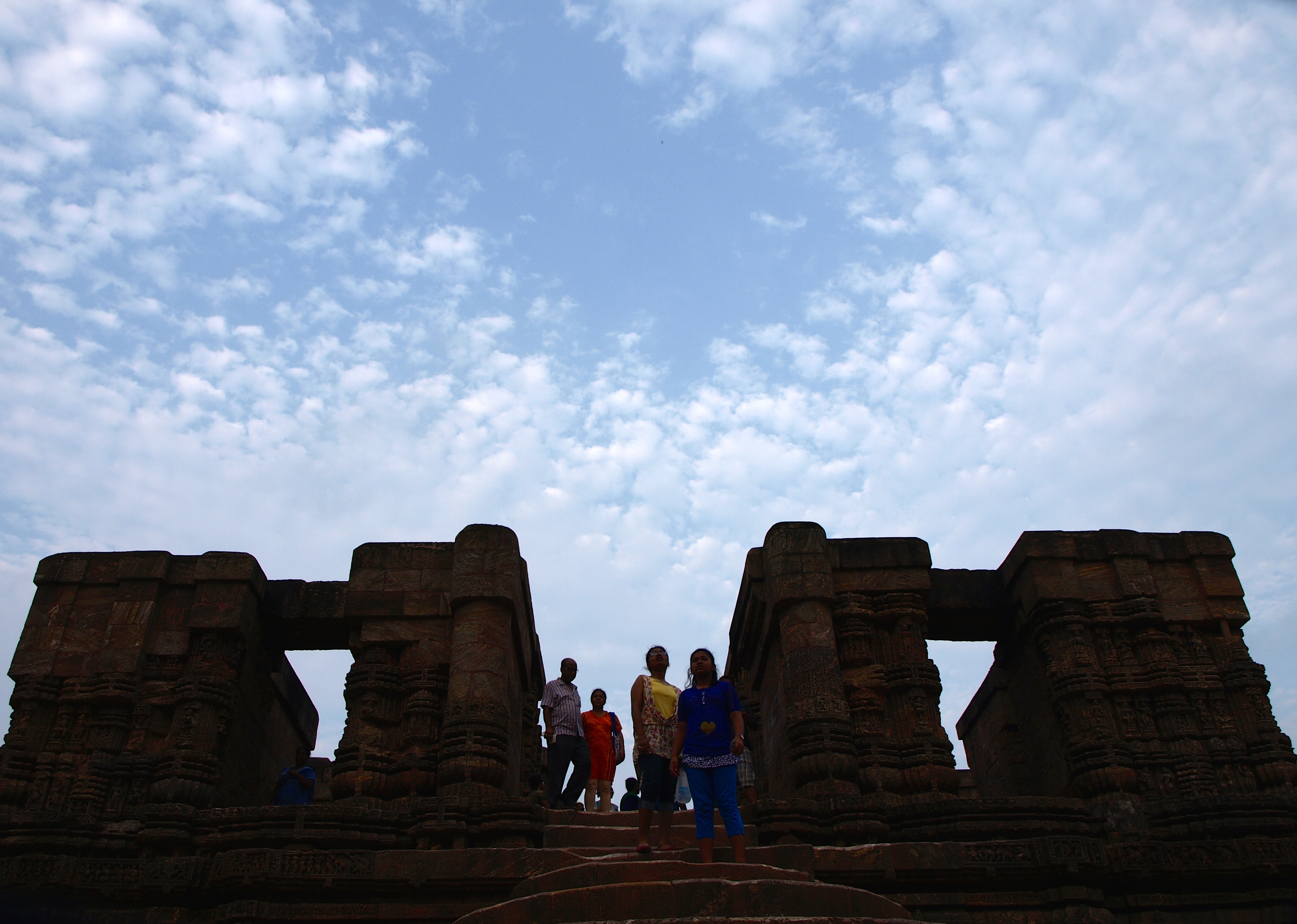
Konark, Odisha
-
- Bundi, Rajasthan
-
- Konark, Odisha
-
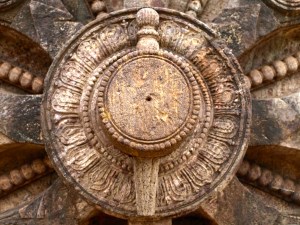
- Konark, Odisha
-
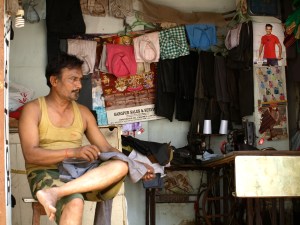
- Puri, Odisha
-
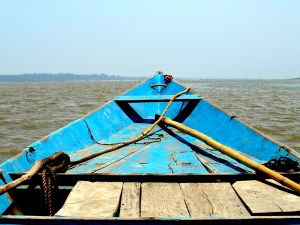
- Chilka, Odisha
History In A Phone
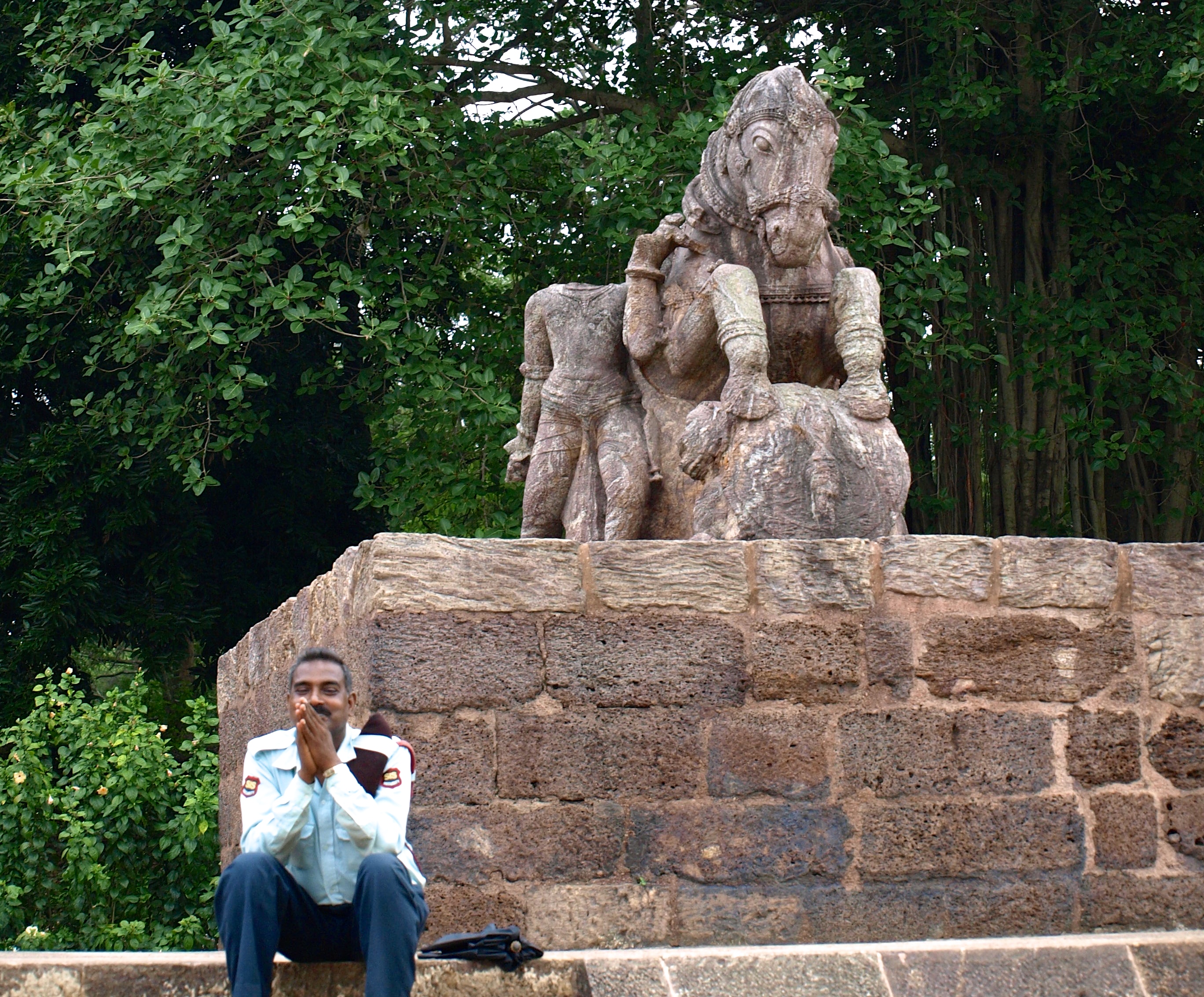
The guard with the phone at the Sun Temple, Konark
By Rahul Sharma
For 14 years Hemant Singh has blown his old whistle every so often to warn tourists to not climb monuments, write on the walls and even urinate in the Konark temple complex in Odisha.
During his day shift he sits on a platform where stands one of the ornate sculpted horses that once adorned the Sun Temple that collapsed long ago. Singh’s eyes dart from one end of the complex to another as hundreds of tourists battle the heat and humidity and jostle with each other to take selfies with the famous wheels of Sun god Surya’s chariot in the background.
“They (the tourists) can do anything. They have no respect for the place,” he says just before blowing into his whistle and waving his hand at a proud father trying to perch his young son on top of a sculpted figure just across the green patch of grass. An umbrella, necessary to beat the dry afternoon heat, lying next to him flutters in the moist evening breeze.
“Arre bhai, mat karo,” he shouts, as an embarrassed father pull his son down in hurry and scampers away. Singh lets out a long, disappointed sigh, shakes his head, and looks at his watch; the cruel summer shift will end soon and he will go home to his family
From Gaya in Bihar, Singh is one of dozens of security guards employed to keep watch on the world heritage site littered with centuries-old stone sculptures. They hang around the baking stones in the summer, minding the tourists. The night shifts are spent in the guardhouse just outside the complex. Snakes, lots of snakes, come out in the dark, Singh says. It is safer not to walk around in the complex.
His eight-hour shifts earn him enough to have moved his family to Konark from his village. “My children are in an English-medium school,” he proudly tells me, adding that he has another 15-odd years in the job before he moves on with memories of a beautiful place, which he has helped keep clean, and in shape.
According to Singh, most tourists have little or no knowledge of the history of the magnificent 13th century structure built by King Narasimhadeva I around 1250 AD. It is widely believed that it took 1200 workmen and artisans 12 years to build the Sun Temple.
And as I look at the ornate horse sculpted out of stone on the raised platform where he sits, Singh asks: “You haven’t got yourself a guide?”
“I have read about the temple and its history. I didn’t need a guide,” I tell him.
“You have read about it but you haven’t heard it, have you?” he asks, fishing out his old, not very smart mobile phone from his pocket when he hears me say no.
He then presses the play button on the phone recorder and hands it to me. “You can hear it here. It’s in my voice,” he tells me proudly.
That’s Singh’s way of appreciating the place and its history, which he has memorized in the 14 years he has been at the temple complex.
“I don’t usually share this with everybody,” he says, as his strong voice plays into my ear through his little phone. By the end of the 15-minute recording I know everything I didn’t already know. Technology has helped Singh bridge the divide between the ancient and the modern.
As I return the phone to him and get up to make my way, he asks me if I liked the little personal experience with history. “Isn’t it better than how the guides will tell you?” he asks.
I look at the setting sun and the long stretching shadows of a temple where no prayers are held and nod my head in agreement. On that hot, balmy, sweat-drenched evening on the shores of the Bay of Bengal, Singh’s was the best voice I had heard.
As A Brand Gandhi Lives On
By Rahul Sharma
Djibouti is not a usual tourist destination.
It is a small country on the Horn of Africa with a population of less than a million. Surrounded by Ethiopia, Eritrea and Somalia, it lies next to Africa’s badlands. The biggest advantage it has is its access to the Red Sea and the Indian Ocean, which makes it a busy refuelling and transshipment centre.
So why am I talking of Djibouti?
Visuals of Prime Minister Narendra Modi paying tribute at a statue of Mahatma Gandhi during his recent visit to the United States reminded me of my trip to the Horn of Africa a few years ago. And to my surprise I found that just as he stands tall outside the Indian embassy in Washington, the Mahatma lives in Djibouti too.
Armed soldiers manned the dusty roundabout where his bust stood when I visited. Stray dogs lazed under military vehicles and bored soldiers hung around, nervously playing with their automatic weapons.
The surroundings were at odds with a man who preached peace and non-violence, but there he was as he is in several countries—bald, round spectacles sitting on his nose, looking at a world where his teachings are still relevant and another that has left him behind.
What was Gandhi doing there, I wondered aloud. Oh, he is everywhere, responded an Indian diplomat who was part of a group visiting Djibouti for the inauguration of a new Dubai-funded port.
Brand Gandhi
Indeed, the Mahatma is omnipresent in afterlife. He is the most famous brand India has produced. The boost to the country’s soft power through his statues and busts that dot public spaces across continents is not only huge, but also enduring. He has now lived in the hearts and mind of billions for nearly 80 years since his assassination. And by the looks of it, he isn’t fading away soon.
The “half-naked fakir”, as Winston Churchill famously called him, is a face probably better recognized than those of most Bollywood actors. In fact, probably better known than that of Churchill, the man who hated the Mahatma and whose rivalry brought the British Empire down.
Gandhi, like Churchill, died a broken man. Politically irrelevant after he guided India to independence, Gandhi’s legacy at home has been constantly debated. However, his contribution to India’s global image is unparalleled.
As British India broke into two and millions of people perished in pre- and post-partition violence, Gandhi, shunned by his disciples, virtually retired, bitterly complaining that nobody listened to him anymore. His murder, by a religious fanatic, however, changed the course of events. In his death he achieved what he couldn’t when he lived—bring a turbulent nation together and stop the gory dance of violence that had enveloped the infant republic.
His martyrdom eventually put him on history’s high pedestal and made him acceptable globally as an apostle of peace, ensuring his brand of politics remained relevant. In India, politicians, convulsing against his political thought, consigned him to school text books—bringing him alive on his death and birth anniversaries for formal ceremonies that involved the twice annual ritual of cleaning bird droppings from his statues and naming public schemes after him.
A different path
Frank Moraes, the editor of The Times of India, recounted a conversation with HSL Polak—one of Gandhi’s close associates in South Africa—in an article he wrote for the Foreign Affairs journal to mark the Mahatma’s 10th death anniversary in 1958. He asked Polak how much of Gandhi’s teaching he thought survived in India. “Ostensibly a great deal… In reality, very little,” said Polak.
Indeed, neither India nor the Congress Party ever accepted Gandhi’s doctrine of non-violence as creed. “The Congress Party, including Nehru and other prominent leaders such as Sardar Vallabhbhai Patel, accepted non-violence but only as a method. With them it was an instrument of political practice, not an article of faith,” wrote Moraes.
In the 56 years since his article, the situation has only worsened. Very little of the Mahatma’s politics has survived in India; we could, however, despite our reluctance, take pride in our ability to export an enduring brand. It is perhaps more relevant to the world than to India, mostly because we have chosen to take a path different from his.
That probably was a good reason why Richard Attenborough’s film on the man many Britons hated won the Oscar for best film. That probably was also the reason for the U.S. Congress to pass a special legislation allowing the Mahatma’s statute in Washington to be installed on government land.
While we, as a nation, use him on occasions of political exigencies, the world only wants more of Gandhi for his political thought.
Myriad Mahatmas
Indeed, the metallic Mahatma is much in demand. Under a well-structured programme run jointly by India’s overseas missions, which work out the modalities of the placement of statues and busts, and the Indian Council for Cultural Relations (ICCR) that pays the sculptors who make the statutes, replicas of the bespectacled apostle of peace are regularly shipped to the world.
Between 2001 and 2010, nearly 70 busts and statues of the Mahatma were sent to dozens of countries by the ICCR. That’s an average of seven a year. The bust I saw in Djibouti was sent in 2003 for installation on a street named after the Mahatma. The cigar chewing Mr. Churchill, who never regretted his long-time rival’s death, hasn’t had it so good!
The Mahatma’s statue is due to be unveiled at the Parliament Square in London next year alongside those of Abraham Lincoln and Nelson Mandela—the man who was so influenced by Gandhi as he led his people to an apartheid-free South Africa. Churchill’s statue is one of the 10 already erected at this place.
Owning Gandhi
Here, at home, he still has an occasional use. The stamp of moral authority that he has left on this nation means the Mahatma—though a Congress man—can be greedily adopted by other political parties when required. Modi’s effort to make him the face of his “Clean India” campaign is just another example of Gandhi’s use for political convenience.
Despite promising to build a towering statue of Patel in the run up to the general elections that swept him to power, Modi now wants his Bharatiya Janata Party (BJP) government to own “Brand Gandhi” and take over the events that mark the death and birth anniversaries of the Mahatma. Up until now, these ceremonies were the responsibility of a special committee constituted by an Act of parliament.
The Mahatma’s adoption by the BJP—the political face of an organization whose members celebrated the Mahatma’s death—is ironic, but then that’s the strength of a brand that has endured the rough and tumble of time.
It’s always long term for China
By Rahul Sharma
There is nothing to be excited about Chinese President Xi Jinping’s decision to skip Pakistan during his forthcoming South Asia tour. Some might argue that it would have been a good time for Xi to land in Islamabad to show support for the country roiled by political uncertainty, but let’s be clear that the call to stay away does not reflect any change in relations between the two long-standing friends.
Xi is due to visit India, Sri Lanka and the Maldives later this month, trips during which he will test prime minister Narendra Modi’s keenness to improve trade ties between the world’s two most populous countries and reaffirm Beijing’s deepening ties with Colombo that has attracted vast amounts of Chinese investments in its infrastructure.
Ties between India and China have always been testy given the border dispute that saw the two go to war back in 1962. Frosty relations have thawed in recent years and trade between the two neighbours has grown, but there is still a long way to go before any degree of mutual trust can be established.
Indian foreign minister Sushma Swaraj said this week that while Modi and Xi had established good relations when they met at the BRICs summit in Brazil soon after general elections in India, she also made it clear that Beijing had been delivered a strong message that it had to respect the “one-India policy (which means no claims on Arunachal Pradesh) given that New Delhi recognised Tibet and Taiwan to be part of China.
One thing India and its diplomats can be clear about is that his decision to skip Islamabad from his tour does not mean China is ready to dump Pakistan. Usually Chinese leaders club their visits to India and Pakistan, but all that a de-linking this time around could possibly do is give New Delhi temporary comfort that at this point it figures higher in Beijing’s priority than in the past.
One thing India and its diplomats can be clear about is that his decision to skip Islamabad from his tour does not mean China is ready to dump Pakistan. Usually Chinese leaders club their visits to India and Pakistan, but all that a de-linking this time around could possibly do is give New Delhi temporary comfort that at this point it figures higher in Beijing’s priority than in the past.
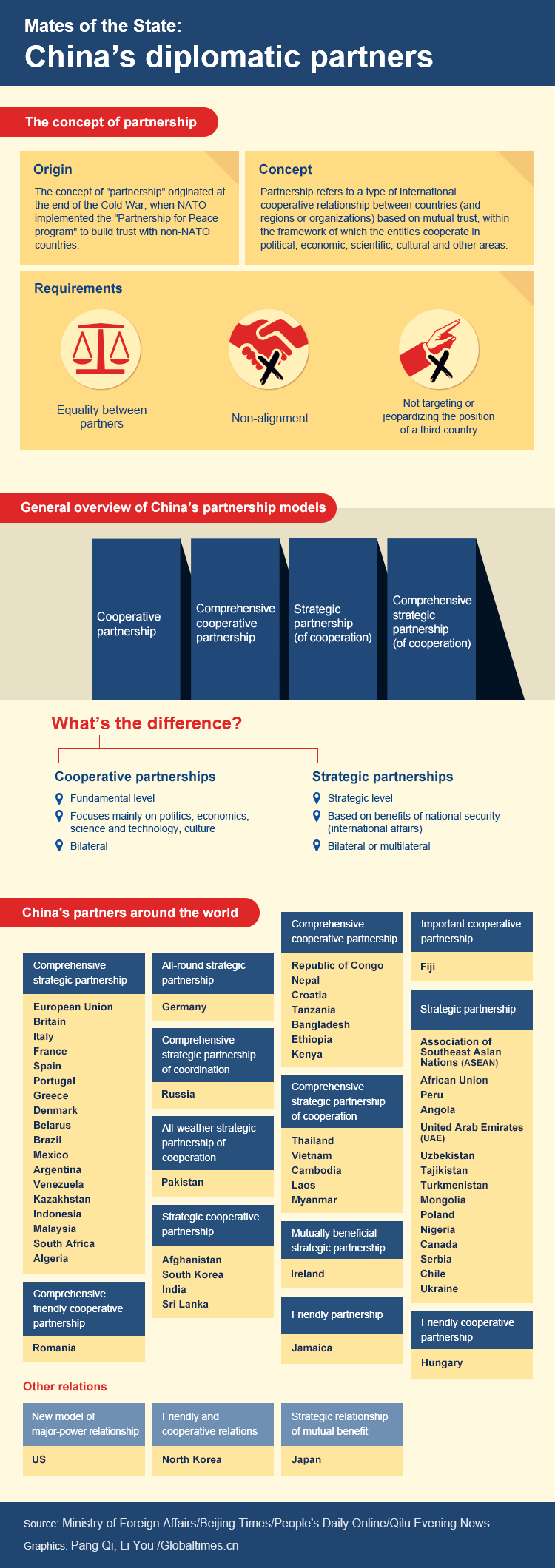
China seldom takes a short-term view of the world, and has clearly defined its relations with other nations on the basis of its long-term goals and needs. A recent info graphic in Global Times, a Chinese government-run newspaper, provided a view of how Beijing divides its worldly ties.
China essentially follows four partnership models: creative partnership, comprehensive cooperative partnership, strategic partnership (of cooperation) and comprehensive strategic partnership (of cooperation). The difference, according to the newspaper, is that while cooperative partnerships are formed at a fundamental level, are bilateral in nature and focus mainly on politics, economics, science and technology and culture, the strategic partnerships can be both bilateral or multilateral and are based on benefits of national security.
While one would imagine that diplomacy and foreign relations are usually dynamic in nature and, therefore, likely to change depending on circumstances, in China’s case one can merrily assume that any shift will only be snail paced with little or no change in the foundation. Foreign policy, like so many other things in China, can be rather nuanced and small variations in definition of relationships can mean a lot more than what the world outside may understand.
So it is interesting to see that China clubs the European Union and most large European nations except Germany and Russia as those with which it has a comprehensive strategic partnership. With Germany it has an “all-round strategic partnership” and with Russia it is in a “comprehensive strategic partnership of coordination”
With India, Afghanistan, South Korea and Sri Lanka, Beijing shares a “strategic cooperative partnership”. That means it sees all of them through the same prism, an idea that may not appeal to India, but might go down well in Kabul and Colombo.
According to the Global Times, China’s ties with ASEAN, central Asian republics, the United Arab Emirates, Canada and some East European countries are seen to be one of “strategic partnership”, while those with Nepal, Congo, Bangladesh and some other key African nations fall under the head “comprehensive cooperative partnership.”
The emerging great power rivalry with the United States and the old, historic unhappiness with Japan has led China to define its relationship with these two very differently than those with other nations of the world.
It calls its engagement with the United States a “new model of major-power relationship”, which means Beijing definitely sees itself in league with Washington, an idea that obviously reflects on its relationships with other capitals. In short that means that while China is willing to engage with all, it doesn’t consider anyone a bigger rival than the United States. Countries such as India are, therefore, mostly marginal to China’s larger cause.
Similarly, its defines ties with Japan as a “strategic relationship of mutual benefit.” Given the huge bilateral trade and Japanese investments in China even as the two battle over a gory past, the definition makes sense.
Pakistan is the only country with which China has an “all-weather strategic partnership of cooperation.” In layman’s terms, it simply means that Beijing considers its relationship with Islamabad over and beyond its ties with all others. The phrase “all-weather” is key; China might be willing to shift gears either way in its relations with other countries, with Pakistan it will always be an even ride just as it has been for the past several decades.
Let’s not forget it was Pakistan that essentially helped Beijing open its door to the world in the 1970s, an event that has now propelled China to almost become the world’s biggest economy. China never forgets its friends and that’s a thought Pakistan can live comfortably with irrespective of whether it has a democratically elected government or army rule.
It’s also a thought India’s new government needs to keep in its mind while dealing with Beijing and Xi, the now all-powerful man in China.
Rahul Sharma, a former newspaper editor, is President, Rediffusion Communications, Mumbai; Secretary, Public Affairs Forum of India, and a keen foreign policy follower. Views are personal.
Bringing Down the Walls
By Rahul Sharma
Most concrete walls in Sri Lanka have been demolished in the past four years since the ethnic war ended, but the emotional barricades remain as the country battles its bloody past and tries to make peace with itself.
It’s easier said than done.
The scars of a three-decade-long war that killed tens of thousands of people and introduced suicide bombers to the world are deep and the government’s efforts to bridge the ravine that divides the majority Sinhala and the minority Tamils communities are constantly questioned inside and outside the country.
On the face of it, peace has only made a pretty country prettier.
The capital Colombo, once infested with check points manned by gun toting soldiers, is a very different place.
Parks hidden by tall walls, homes surrounded by bricks and mortars and colonial-era public buildings once guarded by armed soldiers have emerged from behind sand bags, metal gates and machine gun barricades to soothe public eyes. The concrete, iron spikes and steel wires have given way to beautifully lit walkways where people walk in the mornings and children play in the as the sun sets.
More importantly, there is discipline on the roads and the traffic is managed better than even despite an increasing crowd of vehicles. The once-decrepit, bat-infested Vihara Mahadevi Park near the beautiful, British-era Town Hall in Colombo has been cleaned up and the famous Independence Square is a must-visit place.
Old, heritage buildings nearby — once home to government offices and the military — are being converted into jazzy shopping areas with fancy retail outlets and restaurants.
Colombo, a party town even during the days of the war, is awaiting plush hotels and casinos to come up along the famous Galle Face Green. A new Chinese-developed port stretches out into the Indian Ocean, a sign of huge investments into infrastructure that the government hopes would keep boosting the economy.
Outside of Colombo, new highways to the south and the east and a new railway line to the north have once-again connected the island to allow people to freely travel to areas that were once out of bounds because of the war.
But scratch the surface and there is a deep worry about what the future holds for a country where trained former soldiers are now building roads, running restaurants and even selling vegetables. In the north, where once the rebel Liberation Tigers of Tamil Eelam (LTTE) ruled, are thousands of ‘rehabilitated” former fighters thanking the government for the peace that surrounds them but at the same time looking for jobs and ways to make ends meet.
Despite new roads, bridges, seaports and airports the government has built and is building, and a consequent economic growth of around 7 percent, the mood on the street is somber, as the private sector is still battling to grow at a pace that could create the kind of jobs Sri Lanka needs.
A fat government that provided employment to 50,000 job-seeking youth last year and is battling a widening fiscal deficit can’t continue on that path for long.
On the other hand is the divide between the majority Sinhala and minority Tamil communities. For more than quarter of a century, the Sinhalese equated Tamils with the LTTE as soldiers from deep southern villages lost their lives in the country’s north. The war might have ended, but the ethnic divide is yet to be fully bridged.
Allegations of human rights violations by the Sri Lankan military in the last days of the war and international pressure to come clean on the charges has only made it difficult for the two communities to come closer.
The government of President Mahinda Rajapaksa, who is in his second term and is credited with vanquishing the LTTE, has consistently maintained that what happened back in 2009 was Sri Lanka’s internal matter and that it was being addressed in ways best known to and understood by the country.
However, in a historically violence-prone nation such as Sri Lanka – which not only battled the LTTE but also an attempted revolution by the People’s Liberation Front in the 1970s and 1980s – the chances of acute disgruntlement triggering another bloodbath can be considered to be high. That is what the government of the day has to worry about and ensure that the window for the peace dividend is not lost due to delays in processes.
More importantly, the international stakeholders, including Western governments, need to appreciate that the only people who will be able to solve their differences and build a better future are Sri Lankans themselves. It is easy to voice opinion in an attempt to influence events, but if Sri Lankans have to find peace they have to be left alone and allowed to put in place systems that will help mold a strong future.
Recent regional elections in the country’s north in which a Tamil party won power should be seen as a right step towards bridging the big divide. It is now necessary to build on this, as that’s the only way to bring down the emotional and ethnic walls.
Disquiet In The Neighbourhood
By Rahul Sharma
The taxi driver ferrying me to the airport in Sri Lanka was pretty clear about why the Indian Prime Minister Manmohan Singh had chosen to stay away from the Commonwealth Summit in the capital Colombo this week.
“Your prime minister doesn’t like our president’s closeness to the Chinese,” he declared, as he sped over a spanking new expressway to the airport at Katunayake, a journey that once took nearly two hours but now has been reduced to about 25 minutes.
The taxi driver’s view was remarkably at odds with that of the Sri Lankan government, which is piqued by New Delhi’s decision to stay away after pressure from political parties in Tamil Nadu months ahead of a general election, which is likely to throw up another coalition government.
Sri Lanka is a vastly different place than what it was when a three-decade ethnic war ended in 2009 with the killing of Velupillai Prabhakaran, the leader of the dreaded Liberation Tigers of Tamil Eelam (LTTE) rebels who were fighting for a separate homeland for minority Tamils.
Prabhakaran was a feared man – god to some and terrorist to others – who led a bloody quest that ended tens of thousands of lives on the island, shattered the economy and wiped out most of the political leaders through use of suicide bombers.
There is now a government headed by a confident President Mahinda Rajapakse who, in his second term, is still riding a high after being declared a saviour of the majority Sinhalese community.
Military checkpoints have given way to sparkling pavements, restored buildings and shiny roads. There is a positive buzz around Colombo, where hybrid taxis and fancy cars jostle for space with Bajaj three-wheelers.
One of things that Rajapakse has done in the past few years apart from rebuilding the country is that he has seemingly sold his country to the Chinese, or so many Indians and Sri Lankans would like to believe.
Indeed, the Chinese are everywhere. They are doing what they are very good at – building new highways, bridges, airports, convention centres and ports that are making Rajapakse look extremely good at home. His beaming face looks down from large cutouts that adorn the sides of the new expressways that now connect Sri Lankan cities.
For a nation that witnessed various bloodbaths since the riots against minority Tamils back in 1983 triggered the long war, these are years of change and the Chinese are more than happy to participate in the development process by helping a president who is keen to build political equity for the long term. Indians, on the other hand, have held back to ensure that New Delhi’s domestic political constituency remains stable.
If Singh would have gone to Sri Lanka, he would have been driven on a brand new Chinese built airport expressway to a Chinese built and renovated convention hall for the summit. On the way he could have had a peek at a brand new Chinese-built shipping port in Colombo and many a Chinese restaurants and massage parlours that have sprouted across the capital.
If he went deeper south to Rajapakse’s home town of Hambatota, he would have seen another large port and another convention centre that the Chinese have built. The new highway to Galle on Sri Lanka’s southern tip and another to the eastern port city of Trincomalee also have a Chinese stamp. More importantly, there are more Chinese visiting the country than Indians.
The once disjointed country, broken by war, is now connected the way it was 30 years ago thanks to the Chinese. Are Sri Lankans unhappy about it? No, they aren’t. They appreciate what Rajapakse has done after winning a war his predecessors could not. And the lack of a strong opposition makes him a powerful leader to contend with.
And what is India, which once held sway over Sri Lankan politics and economy, doing about negating the increasing Chinese influence on the island? Precious little, to say the least. The Indian contingent is standing by the tracks watching the Chinese win a race that was once New Delhi’s to take, thanks to state-level politics that binds its hands.
Rajapakse is a grassroots politician who understands the pulse of his voters better than most in Sri Lanka; he also understands that while hobnobbing with the Chinese is beneficial, India can’ be wished away completely. He wants to stay engaged, but at his terms.
It’s a smart move. If things go wrong again in the Tamil-dominated north and east, he can happily put the blame on India’s door. If not, he can take the credit for working with India to help the minority. The south is not a worry for him – at least not yet – as that’s his majority Sinhalese political base.
The good news for India is that it is still appreciated among large chunks of a country which, like many others, could soon reach a point when it begins distrusting the Chinese.
The immigration officer at the airport says that Chinese were different from Indians and that the Indian prime minister’s participation in the Commonwealth Summit would have helped New Delhi earn critical brownie points against Beijing. “Your prime minister should have come,” he said, as he stamped my passport and waved me off with a wry smile.
Yes, the prime minister should have gone, if only to keep the tiny neighbour happy. Singh’s absence may not necessarily push the Sri Lankans deeper into the Chinese arms, but it would definitely make it slightly more difficult for New Delhi to do business with Colombo. Given its chaotic neighbourhood, India needs to keep its friends; not turn them into indifferent acquaintances.
(The columnist, a former newspaper editor, is President, Public Affairs, Genesis Burson-Marsteller and co-founder of Public Affairs Forum of India. He has a keen interest in China and Southeast Asia. Views are personal)
It’s The Jobs, Stupid
By Rahul Sharma
There is a very good reason why Narendra Modi speaks to India’s young and exhorts them to vote the current Congress-led government out. He understands the simmering discontent among the country’s massive young population that is out looking for jobs and not finding any unlike other politicians who still believe only in politics of dole, caste and religion.
The state of the young in India is dismal and the mood gray. A slowing economy and high cost of living have only added to their woes. Add to that the fact that business sentiment will continue to be poor for the next several months in the run up to the elections – and even after that if a sustainable government doesn’t come to power – and you see a horribly potent recipe for social unrest.
Modi knows that if the young – a brand new, vibrant constituency — start believing that he will get those jobs and the financial sustainability that would let them buy all the gadgets, goods, automobiles and apartments, they would come out in throngs and help him win next year’s general elections.
Given the state of India’s shrinking job market into which 12 million youth trundle in every year, Modi’s call resonates well not only in large urban centres, but also the smaller towns where aspirations and opportunities have made traditional roles redundant.
So how badly off is the situation?
If you believe a new Confederation of Indian Industries-Economic Times (CII-ET) survey of India’s young, it’s pretty nasty out there. Of its 1.2 billion people, 800 million are less than 35 years old – and they seem to be really upset with the way things are.
According to the survey, findings of which were published in The Economic Times, three out of four of them believe that the economy today is worse off than it was in the aftermath of the 2008 global financial crises. More than half say it is the worst time to look for jobs and nearly 60 percent have postponed buying a house, a car or having children. Worse, nearly 40 percent of the people polled in 28 cities said they won’t mind taking a pay cut if that improves their chances of holding on to a job.
It can’t get worse for the Congress; and it can’t be better for Modi and his Bharatiya Janata Party (BJP), which is still looking for that one issue that could change its fate and bring it out of its decade-long political wilderness.
“This is the most disturbing micro impact of the macro slowdown,” the newspaper quoted Rajya Sabha MP and entrepreneur Rajeev Chandrashekkhar as saying. According to him, educated Indians looking for their first or second jobs are hurting the most.
Thousands of engineering, medicine and businesses schools in India produce millions of graduates each year. But they hit a hard wall when they get into the job market. The impact is two pronged. Fewer jobs also mean there aren’t many takers for the seats in the graduate and post-graduate schools, many of which are beginning to shut down.
“The following set of numbers shows the young have read the grim job market right. Andhra Pradesh has over 700 engineering colleges and 350,000 seats – the highest in any Indian state. But just 200,000 seats were filled up this year. Why? Because just 20% of the class of 2013 have got jobs. When young Indians give up the chance of getting an engineering degree, you know there’s something very wrong,” the Economic Times wrote.
The other, bigger, impact is on the consumer, automobile and real estate markets, which are now losing their sheen as poor demand pulls the economy down. No wonder, the government is being forced to ask state-owned banks to offer cheaper loans for consumer goods and two-wheelers to boost demand in an otherwise depressing economy.
These are problems only politicians can address. There is a need for a fresh thinking and new policies that could create more jobs, both in the manufacturing and services sector. There is a need to lift business sentiment so that investments on hold can be channeled into infrastructure and other industries that would create jobs. These are issues that can’t be solved overnight, but if you have a large chunk of your population that is either unemployed or underemployed, you have a huge problem on hand.
If you believe Modi, then he probably understands the issues better than other politicians. The Congress doesn’t seem to have a solution, nor can it explain its lethargy in fixing the situation in the 10 years that it has ruled India. The grand old party is not even talking about jobs – at least not yet. A disgruntled youth is not good for politicians and the country. The leader who can show a way to the youth stuck in between a rock and hard place is likely to win the next election.
It is up to politicians and the next government to take the right steps.
 This Day And That