A Master Storyteller of Science, History, and Human Curiosity
Dr. W.C. Minor, an American Civil War surgeon and violent paranoid schizophrenic, walked into my home one pleasant but dark night many years ago. His story captivated me and the book — The Professor and the Madman – which so beautifully recounted the good doctor’s contribution to the making of the Oxford Dictionary became my favourite.
So did Simon Winchester, the author.
Over the years I have read several of Winchester’s books, all of which have been not only informative, but also rather enchanting – masterclass in subjects beyond a common day’s reading – geology, earthquakes, oceans, cartography, linguistics and land. While Minor’s story reads like a detective thriller, the history of the Atlantic and Pacific Oceans read like a biography of an old friend. And that’s where Winchester scores!
What distinguishes Winchester — who studied geology at Oxford University but later became a journalist before he sat down to start penning his books — from other popular science and history writers is his voice that is warm, witty, and almost conspiratorial. It is amazing how he makes technical things seem personal. His ability to explain tectonic plate movement or the mechanics of ocean currents in simple words not only make it easy for readers to understand them better but also memorable. His curiosity is contagious; so is his storytelling.
Winchester’s books are usually built around a single object, event or personality — a dictionary, a map, an earthquake, a madman — and then uses that focal point to throw a lot of surprising information to the larger world. Readers who might never pick up a straightforward history of Victorian science find themselves captivated by his approach because the human drama is always front and centre, with history and science woven around it.
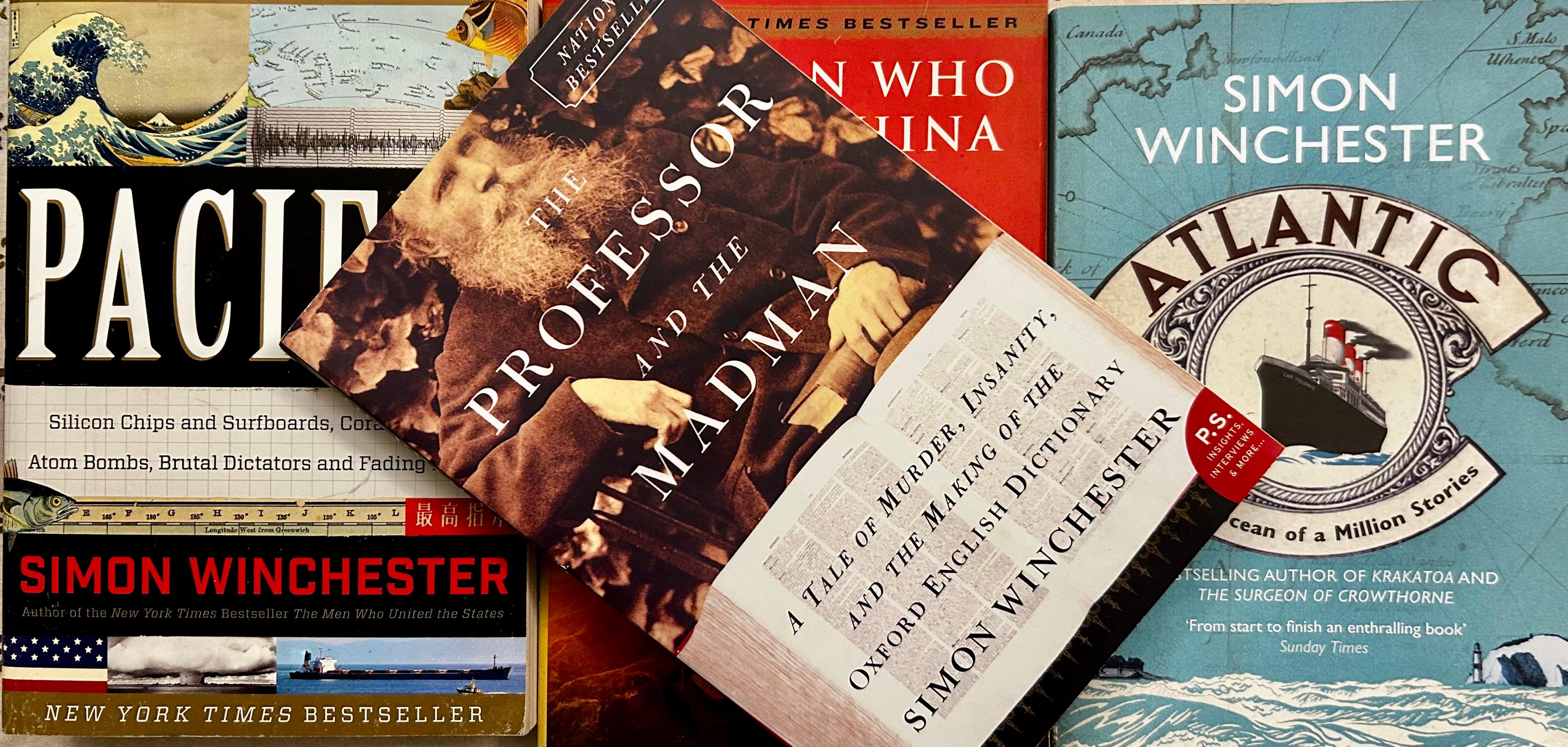
He has written on a remarkable range of subjects — from the creation of a dictionary to making of a modern map and strange stories about tools we use every day. His geological interests come through most powerfully in Krakatoa: The Day the World Exploded, a gripping account of the catastrophic 1883 volcanic eruption in the Sunda Strait off Indonesia that killed tens of thousands and altered the global climate. The historically important disaster is seen through a lens that examines deep depths of earth, colonial history and the birth of modern telecommunications. The news of the explosion that could be heard as far as in Mauritius travelled quickly all the way to New York thanks to newly laid telegraph lines.
Similarly, A Crack in the Edge of the World revisits the catastrophic 1906 San Francisco earthquake with the same geological rigor and narrative flair, exploring how that disaster reshaped not just a city but a nation’s understanding of the ground beneath its feet.
His most celebrated books, however, concern the world of ideas and language. The Professor and the Madman — his breakthrough bestseller — tells the astonishing true story of Dr. W.C. Minor who, while confined to Broadmoor asylum in England, became one of the most prolific contributors to the Oxford English Dictionary. It is a story about obsession, redemption, and the strange ways genius can manifest. The Meaning of Everything followed as a companion volume, chronicling the full history of the OED’s creation with equal fascination.
The Map That Changed the World tells the story of William Smith, the canal digger who created the first geological map of Britain in the early 19th century and, in doing so, helped lay the foundations of modern geology. In The Atlantic: Great Sea Battles, Heroic Discoveries, Titanic Storms, and a Vast Ocean of a Million Stories he audaciously wrote a biography of an ocean.
More recently, The Perfectionists: How Precision Engineers Created the Modern World turns to the history of precision manufacturing, tracing how the demand for ever-finer tolerances gave rise to the industrial age, mass production, and ultimately the microchip. It is a subject that sounds dry on paper but, in Winchester’s hands, became a satisfying story of human ingenuity. Land: How the Hunger for Ownership Shaped the Modern World ventures into history, politics, and philosophy to examine humanity’s fraught relationship with land ownership — one of his most ambitious and timely books.
In an age of increasing specialization, Simon Winchester stands proudly as a generalist — a writer who believes that everything is connected, that geology informs history, that a dictionary is a window onto civilization, that the story of a single earthquake can illuminate the forces shaping our entire planet. His books are invitations to see the world more carefully and more wonderingly than before. Here is a list of his books that I have thoroughly enjoyed reading – on flights, in trains, on holidays and on just a lazy Sunday afternoon.
Selected Bestsellers by Simon Winchester
• The Professor and the Madman (1998)
• The Map That Changed the World (2001)
• Krakatoa: The Day the World Exploded (2003)
• The Meaning of Everything (2003)
• A Crack in the Edge of the World (2005)
• The Atlantic (2010)
• The Perfectionists (2018)
• Land: How the Hunger for Ownership Shaped the Modern World (2021)

