From China to Japan, the Philippines to India, nations prepare for more volatility. Read more here.
Tag Archives: India
Two Conversations
The first was with an old friend who now lives in the United States. We go back 35 years, studied journalism together and shared an apartment for some years.
We have, what my wife says, “venting calls” ever so often. Both he and I belong to a different time and are mostly unable to comprehend why we as people are the way we are when we always have had the option of being otherwise.We make predictions — political and economic — and they mostly come true.
Not so long back we had discussed the possibility of the Covid virus hitting India hard and mutually agreed we could potentially witness a catastrophe. We predicted reasons that would lead India into a dark tunnel where the only light would be those of many pyres. I don’t want to list them, but they all came true.
The other morning we spoke again and tried to not despair even as we talked about what this latest surge was doing to India and Indians — friends, families, colleagues, acquaintances, neighbours and even strangers. He told me he had lost a few relatives to Covid and his elder brother was in the ICU for the past five days. I told him about the challenges we as a people, a nation, were facing. He was sounding brave, but I knew he was rattled.
There is little he can do sitting far except worry. He said he had hardly been able to focus on work in the past 10 days because of the deaths in his family.We spoke about our journey as journalists, worried over the current state of the media and wondered when and where this would end.
He told me to get my sons out of the country, reminding me of a story about one of his relatives who always said he believed in the “Quit India Movement” and had, therefore, first sent his children overseas and then followed them.We also tried to look for funny things in these dire times and laughed nervous laughs.
At one point he got distracted, as his wife called out from another part of his house as he laughed. “No, no I am not crying” he told his wife.
We got to start getting very worried when our laughs begin to sound like sobs. Also when Supreme Court judges and children of politicians die, friends and relatives don’t get oxygen and common people have to be cremated by the roadside because cremation grounds have run out of space.My second conversation was with someone who had a role in saving my life when I was struck by Covid and had to be hospitalised back in December.She’s a nurse at the hospital I was admitted to.
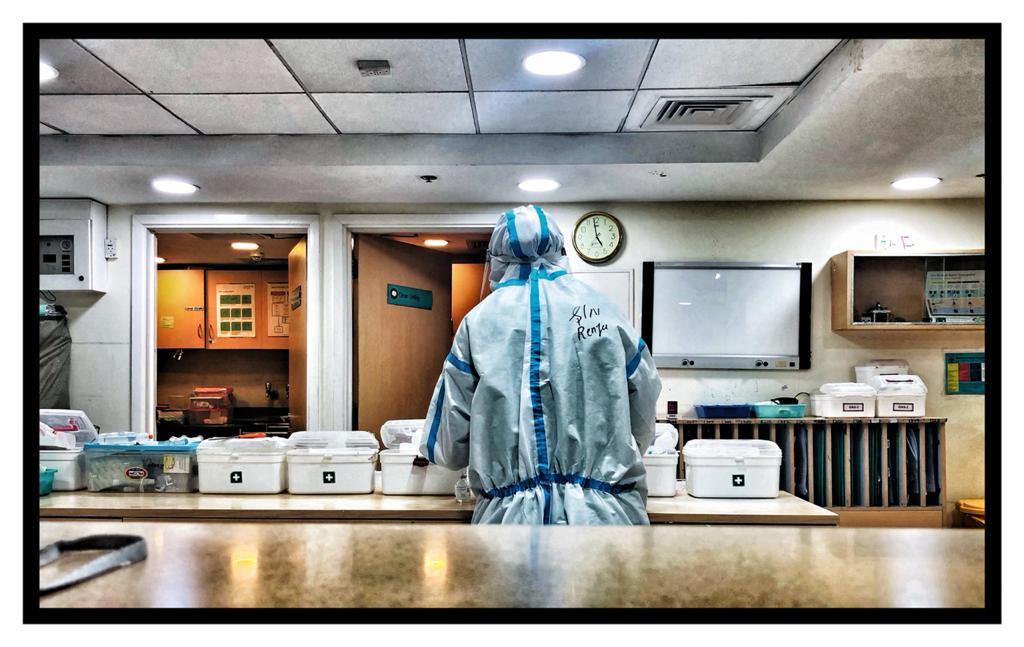
I don’t know what she looks like as everybody was wrapped in PPE suits, but she had dancing eyes and her voice was always calm. She was around for the first seven days of my stay in hospital and then she had a two-day break before she returned to bid me goodbye when I was discharged. “Don’t come back,” she said joyously, wagging a finger.
Large chunk of positivity
She had a steady hand and was happy to chat about her family and dreams and career as nurse. She became my source of information and there was a lot to learn from her about Covid, patient care, situation in the hospital, the tough cases and the deaths in the ward. She would also happily announce the number of patients who were recovering.
There was always a large chunk of positivity around her, which was welcome in an otherwise depressing place.
It struck me that she and her other colleagues who nursed me back to my feet and helped me get through a rather trying period would be in the midst of another battle as patients flowed in the second surge.I messaged her, asking how she was. I received a big smiley back.
“Haan ji, bilkul theek”, she wrote, asking me how I was doing. I asked her what it was like at the hospital, and she responded matter of factly.Patients are very critical. They are unable to hold oxygen (oxygen levels are volatile). Patients were much stable during the last surge.
This virus was definitely a new variant, she said.I asked her whether she was managing well and she said she was, that she was on night duty and asked me to look after myself.I then said I hoped her family was well. “I hope so,” she said, adding that her mother and younger brother had cough.
As always, I marvelled at her equanimity, her dedication to her work and the selflessness with which she cared for patients — stuck in that spacesuit and sweating under double masks and rubber gloves for many hours.I told her that I considered myself lucky that I survived. “Yessss,” she wrote back.
Her display picture on WhatsApp tells more about her. “Shukr hai rabba tune mainu dukh sehna sikhaya, kisi nu dukh dena nahin.” She is just one of the tens of thousands of frontliners in this battle we are all waging. We should be grateful to people like her.
Not Your Tibetan Buddhism
Far from being easy to grasp and anodyne, Tibetan Buddhism is rich in tantric practices, the impenetrably esoteric ideas and techniques used to try to slingshot spiritual seekers directly towards the enlightenment they seek to attain within this lifetime to best help others.
Western Philosophy Is Racist
Mainstream philosophy in the so-called West is narrow-minded, unimaginative, and even xenophobic…how else can we explain the fact that the rich philosophical traditions of China, India, Africa, and the Indigenous peoples of the Americas are completely ignored by almost all philosophy departments in both Europe and the English-speaking world?
The Madras Observatory: From Jesuit Cooperation To British Rule
The Madras Observatory offers little to the visitor’s eye. Stone slabs and broken pillars lie ignored in a fenced-off section of a local weather centre in the southern Indian city of Chennai. Few tourists venture out to see the ruins of the 18th-century complex…Yet it is the Madras Observatory, and not the spectacular Jantar Mantars, that marks the triumphal fusion of scientific knowledge and imperial power.
Parched Before The Arriving Rains
This May should also be remembered for its cornucopia of outlandish riches — $900 billion in China’s save-the-world-from-poverty investment, a $350 billion envelope to President Trump to help Muslims defeat each other, and a $250 billion Indian plan to turn its traders into manufacturers of sophisticated weapons.
A Much-Maligned Mughal
Aurangzeb Alamgir, the sixth ruler of the Mughal Empire, is the most hated king in Indian history. He ruled for nearly 50 years, from 1658 until 1707, the last great imperial power in India before British colonialism. According to many, he destroyed India politically, socially and culturally.
This One Is Scary
The last paragraph of a fascinating book on what is the world’s biggest problem — population.
“Over the next 15 years some 2 billion new babies will be born, 2 billion children will need to commence school, and 1.2 billion young adults will need to find work. In addition, the fastest-growing age group globally will be over 60s. Acknowledging the importance of age-structural change, and ensuring that it is integrated into national and international policymaking, will be essential as the globe transitions from a predominantly younger to a predominantly older world.”
We all need to think about this one.
(Excerpt from: How Population Change will transform Our World by Sarah Harper)
India May Not Like It, But Sri Lanka Can’t Move Completely Away From China
Buried under billions of dollars of Chinese debt, Colombo has little option but to go along, albeit at a pace slower than earlier. After all, Chinese money did prop up the war-battered economy and created jobs. and this did help the government in ending the war against the Liberation Tigers of Tamil Eelam. The Chinese know that while the wicket might be sticky at this point, the pitch will eventually help the ball turn their way.
It’s always long term for China
By Rahul Sharma
There is nothing to be excited about Chinese President Xi Jinping’s decision to skip Pakistan during his forthcoming South Asia tour. Some might argue that it would have been a good time for Xi to land in Islamabad to show support for the country roiled by political uncertainty, but let’s be clear that the call to stay away does not reflect any change in relations between the two long-standing friends.
Xi is due to visit India, Sri Lanka and the Maldives later this month, trips during which he will test prime minister Narendra Modi’s keenness to improve trade ties between the world’s two most populous countries and reaffirm Beijing’s deepening ties with Colombo that has attracted vast amounts of Chinese investments in its infrastructure.
Ties between India and China have always been testy given the border dispute that saw the two go to war back in 1962. Frosty relations have thawed in recent years and trade between the two neighbours has grown, but there is still a long way to go before any degree of mutual trust can be established.
Indian foreign minister Sushma Swaraj said this week that while Modi and Xi had established good relations when they met at the BRICs summit in Brazil soon after general elections in India, she also made it clear that Beijing had been delivered a strong message that it had to respect the “one-India policy (which means no claims on Arunachal Pradesh) given that New Delhi recognised Tibet and Taiwan to be part of China.
One thing India and its diplomats can be clear about is that his decision to skip Islamabad from his tour does not mean China is ready to dump Pakistan. Usually Chinese leaders club their visits to India and Pakistan, but all that a de-linking this time around could possibly do is give New Delhi temporary comfort that at this point it figures higher in Beijing’s priority than in the past.
One thing India and its diplomats can be clear about is that his decision to skip Islamabad from his tour does not mean China is ready to dump Pakistan. Usually Chinese leaders club their visits to India and Pakistan, but all that a de-linking this time around could possibly do is give New Delhi temporary comfort that at this point it figures higher in Beijing’s priority than in the past.
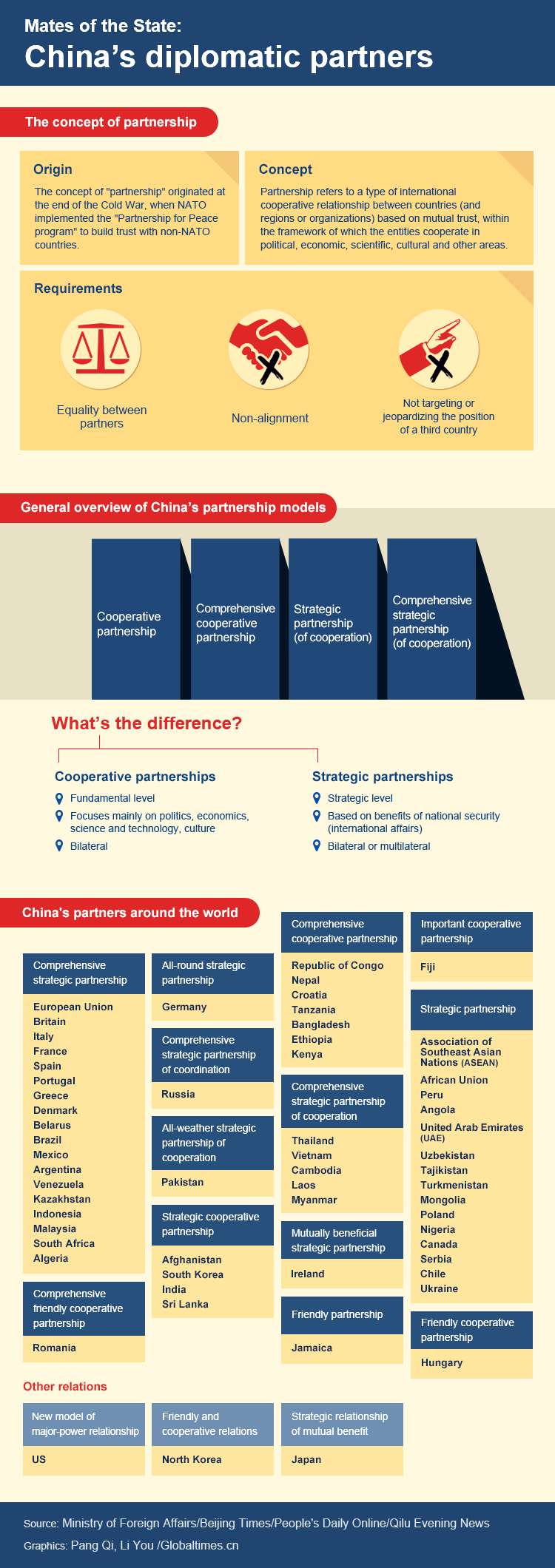
China seldom takes a short-term view of the world, and has clearly defined its relations with other nations on the basis of its long-term goals and needs. A recent info graphic in Global Times, a Chinese government-run newspaper, provided a view of how Beijing divides its worldly ties.
China essentially follows four partnership models: creative partnership, comprehensive cooperative partnership, strategic partnership (of cooperation) and comprehensive strategic partnership (of cooperation). The difference, according to the newspaper, is that while cooperative partnerships are formed at a fundamental level, are bilateral in nature and focus mainly on politics, economics, science and technology and culture, the strategic partnerships can be both bilateral or multilateral and are based on benefits of national security.
While one would imagine that diplomacy and foreign relations are usually dynamic in nature and, therefore, likely to change depending on circumstances, in China’s case one can merrily assume that any shift will only be snail paced with little or no change in the foundation. Foreign policy, like so many other things in China, can be rather nuanced and small variations in definition of relationships can mean a lot more than what the world outside may understand.
So it is interesting to see that China clubs the European Union and most large European nations except Germany and Russia as those with which it has a comprehensive strategic partnership. With Germany it has an “all-round strategic partnership” and with Russia it is in a “comprehensive strategic partnership of coordination”
With India, Afghanistan, South Korea and Sri Lanka, Beijing shares a “strategic cooperative partnership”. That means it sees all of them through the same prism, an idea that may not appeal to India, but might go down well in Kabul and Colombo.
According to the Global Times, China’s ties with ASEAN, central Asian republics, the United Arab Emirates, Canada and some East European countries are seen to be one of “strategic partnership”, while those with Nepal, Congo, Bangladesh and some other key African nations fall under the head “comprehensive cooperative partnership.”
The emerging great power rivalry with the United States and the old, historic unhappiness with Japan has led China to define its relationship with these two very differently than those with other nations of the world.
It calls its engagement with the United States a “new model of major-power relationship”, which means Beijing definitely sees itself in league with Washington, an idea that obviously reflects on its relationships with other capitals. In short that means that while China is willing to engage with all, it doesn’t consider anyone a bigger rival than the United States. Countries such as India are, therefore, mostly marginal to China’s larger cause.
Similarly, its defines ties with Japan as a “strategic relationship of mutual benefit.” Given the huge bilateral trade and Japanese investments in China even as the two battle over a gory past, the definition makes sense.
Pakistan is the only country with which China has an “all-weather strategic partnership of cooperation.” In layman’s terms, it simply means that Beijing considers its relationship with Islamabad over and beyond its ties with all others. The phrase “all-weather” is key; China might be willing to shift gears either way in its relations with other countries, with Pakistan it will always be an even ride just as it has been for the past several decades.
Let’s not forget it was Pakistan that essentially helped Beijing open its door to the world in the 1970s, an event that has now propelled China to almost become the world’s biggest economy. China never forgets its friends and that’s a thought Pakistan can live comfortably with irrespective of whether it has a democratically elected government or army rule.
It’s also a thought India’s new government needs to keep in its mind while dealing with Beijing and Xi, the now all-powerful man in China.
Rahul Sharma, a former newspaper editor, is President, Rediffusion Communications, Mumbai; Secretary, Public Affairs Forum of India, and a keen foreign policy follower. Views are personal.
 This Day And That