Five burials, one wrong ocean, and the city that grew rich on the mistake.
He is carried, even in death, by others. Four stone kings — Castile, Aragon, Navarre and León — hoist the coffin on their shoulders, a sarcophagus that seems perpetually in transit, which is entirely appropriate.
The first thing you encounter when you walk into the Cathedral of Seville is the tomb of Christopher Columbus, and the first thing you realise, if you know the story, is that this is not so much a resting place as it is the latest stop on a very long and disputed journey. He has been buried five times. He is still, arguably, not done.
Columbus died in Spain’s Valladolid on May 20, 1506 — unremarkable rooms, diminished circumstances, a man who had found an entire hemisphere and returned home to argue with accountants about his back pay.
His body went first to the Convent of San Francisco in Valladolid, then was transferred at his son Diego’s instruction to the Carthusian monastery of Santa María de las Cuevas in Seville, a place Columbus had loved in life and used as a retreat before his voyages. So far, it was all rather ordinary. Then things got complicated.
The Five Burials
His wish — stated, reiterated, and finally honoured by his daughter-in-law María de Toledo — had been to be buried in the New World, in the lands he had found. Around 1542, his remains crossed the Atlantic to the Cathedral of Santo Domingo in Hispaniola, the first permanent European city in the Americas.
There he lay for two centuries, through hurricanes, pirates, earthquakes and poverty. When France acquired the territory in 1795, Spain would not leave Columbus to French soil. His remains were exhumed and sailed to Havana.
When Spain lost Cuba in 1898, the bones came home again, arriving in Seville on the back of imperial defeat. The elaborate tomb we see today — four stone kings, a theatrical procession frozen mid-stride — was installed in 1899. It was, in part, a statement of grief dressed up as honour.
There is a final, gloriously unresolved wrinkle. In 1877, workers repairing the Santo Domingo cathedral found a lead box inscribed with the words: Illtre. y Esdo. Varon Don Cristoval Colon — the distinguished man, Christopher Columbus. The Dominicans have always maintained that the Spaniards took the wrong box in 1795, and that the real Columbus never left the island at all.
DNA testing conducted between 2003 and 2005 confirmed that the bones in Seville belong to the Columbus family — but the Seville tomb contains only about twenty percent of a complete skeleton. The bones in Santo Domingo have never been tested.
It is entirely possible that Columbus is in both places at once, which is, when you think about it, a perfectly appropriate state for a man who spent his life between worlds he could not quite name.
The India He Never Found
The misunderstanding that made all this history possible was, at its core, a geographic one. Columbus sailed west convinced he was finding a shorter route to Asia — to the Indies, to the spice ports and gold bazaars that Marco Polo had described. He called the people he encountered Indios and died insisting, against all mounting evidence, that the islands he had reached were the outer edges of Asia. It was Amerigo Vespucci — who would later work in Seville at the very institution Columbus’s voyages made necessary — who argued, more persuasively, that this was something else entirely. A new world. They named the continents after Vespucci, not Columbus. Mr C. would have found this infuriating.
What he found instead of India was something the Europeans had not imagined: an Atlantic world, a vast and populated hemisphere with its own civilisations, calendars, gods and gold. The gold, incidentally, changed everything — and nowhere did it change things more radically, more suddenly, than in Seville.
The City That The Error Built
Stand at the corner of the Cathedral and look across at the long, colonnaded building that faces it: the Archive of the Indies, its stone warm in the afternoon light. It was built as a merchants’ exchange — the Lonja de Mercaderes — because by the 1580s, when Philip II commissioned it, the traders of Seville had grown so numerous and so rich that they were conducting their business on the very steps of the Cathedral. The building that now houses every letter, map, contract and cargo manifest from four centuries of the Spanish empire was built because the commerce of the New World had outgrown the street.
The transformation began with a royal decree. On January 20, 1503, Queen Isabella established the Casa de Contratación — the House of Trade — in Seville, granting the city the exclusive right to conduct commerce with the New World. Every ship bound for America had to depart from Seville. Every ship returning had to arrive there. Every gram of gold and silver had to be registered, taxed at twenty percent and processed here before it could circulate anywhere in Spain or Europe. Seville did not merely participate in the wealth of the Americas. It was the lock through which all of it had to pass.
The city exploded. The population tripled in the sixteenth century. Genoese bankers — Italians had always followed money, and the money was here — congregated on the marble terrace around the Cathedral. The largest guilds were embroiderers, silversmiths, engravers, painters, glaziers.
Vespucci himself served as the Casa’s chief navigator, the piloto mayor, training sailors for the Atlantic crossing until his death in 1512. Seville had become, within a single generation of Columbus’s first voyage, one of the wealthiest and most cosmopolitan cities in Europe.
The Casa maintained something extraordinary: the Padrón Real, the official map of the world, constantly updated as each returning expedition brought new coastlines, new islands, new rivers. It hung under permanent guard, because the maps were the empire. Every pilot who crossed the Atlantic was given a copy. The true treasure flowing into Seville, one might argue, was not the silver — it was the knowledge of where things were.
What The Alcazar Remembers
Walk five minutes from the Cathedral and you are in the Real Alcázar, the royal palace begun by Moorish kings and continuously elaborated by every subsequent ruler. This is where Columbus was received when he returned from his second voyage — not in Castile, not in Madrid, but here, in rooms that still bear the geometries of the Arab craftsmen who built them, amid tilework and muqarnas and garden channels that feel more Marrakech than Madrid.
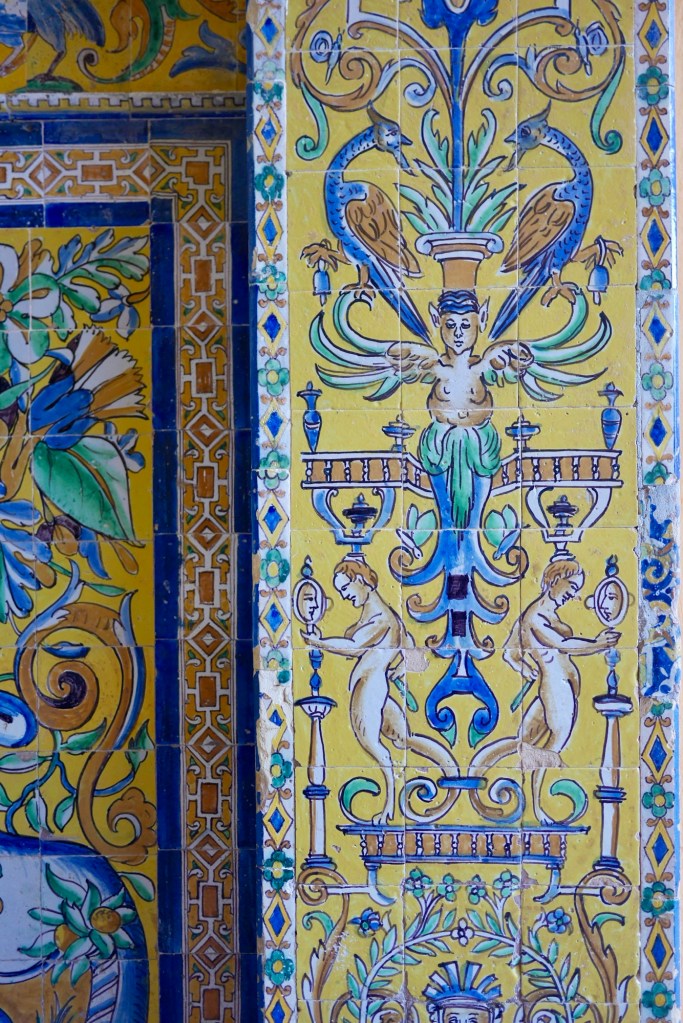
The aesthetic inheritance of the Arabs sits in every surface of this city: in the yellow and blue ceramics that fill the souvenir shops of Triana, in the tiles of the Plaza de España, in the very name Guadalquivir — from the Arabic al-wadi al-kabir, the great river — that carried Columbus’s ships to the sea.
In the Alcázar’s Sala de Audiencias hangs a large painting called the Virgin of the Navigators, painted around 1535. She spreads her cloak wide, and sheltering beneath it are the figures of the age of discovery — conquistadors, explorers, the men who sailed west. Columbus may be among them; scholars debate which figure is his.
The painting is an act of official memory, the empire composing its own legend while it was still happening. What it does not show, because paintings of this kind never do, is the world that existed on the other side of those ships — the millions who did not shelter under any cloak.
Bones And Questions
Back in the Cathedral, in the fading afternoon light that enters through windows the color of amber and deep sea, I stand in front of the tomb again. The four kingdoms — Castile, Aragon, Navarre, León — bear the weight without expression. The coffin they carry is, in all probability, partly Columbus and partly not. It is a monument to a journey that began in confusion and ended in one. He set out to find India. He found America. He never admitted the difference. He was buried five times. His remains are split between a cathedral in Spain and a lighthouse in the Caribbean.
And yet Seville is, in a very real sense, the city that his confusion built. The gold and silver that arrived here because Columbus pointed his ships in the wrong direction and kept sailing built the churches, funded the art, drew the merchants, created the monopoly, and made this city the gateway of a world it had not suspected existed.
The Archive of the Indies, the Alcázar, the ceramics of Triana, the tilework, the flamenco rhythms that absorbed the grief and the distance of displacement — all of it rests, in some way, on the foundation of that first magnificent miscalculation.
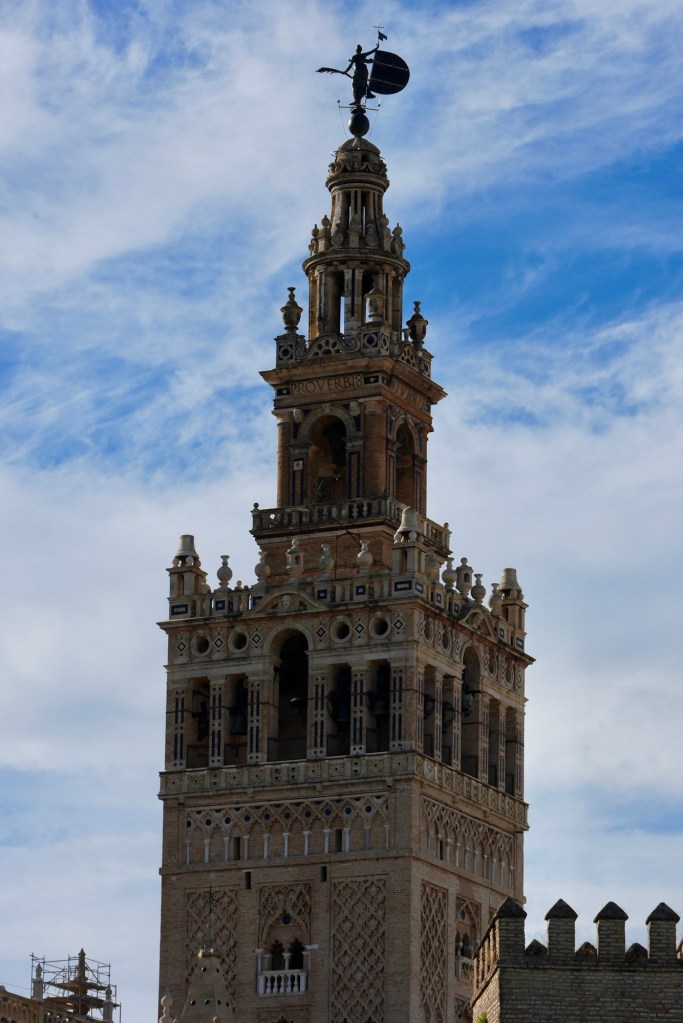
As I look at the Cathedral’s massive doors — the Cathedral itself, the largest Gothic building in the world, built on the site of the great mosque, which was built where a Roman temple stood, which was built where someone before them had already built something — I think about how history in Seville is not a sequence but a palimpsest. Everything written over everything else, and all of it still faintly legible if you know how to read the light.
Columbus did not find India. He found something that remade the world. Seville took its cut, and the cut was glorious, and brief, and it is still here in the stones, in the archive, in the four kings carrying a coffin through a nave that has no end.

