In Murshidabad, the Bhagirathi river moves slowly. It always has. Narrower than the Ganga it once was, silted and quieter now, it slides past the great yellow facade of the Hazarduari Palace with the indifference of a river that has seen too much and for too long.
On its far bank, across a short ferry crossing, lies Khushbagh — the Garden of Happiness — where Siraj-ud-Daulah, the last independent Nawab of Bengal, sleeps in a grave surrounded by mango trees. The past and the present press together in Murshidabad with an intimacy you will not find anywhere else in India.
Last week Murshidabad voted in the first round of state polls to elect representatives to the 294-member West Bengal Legislative Assembly, with incumbent Chief Minister Mamata Banerjee seeking a fourth straight term. The second, and final phase of voting will be on Wednesday. Results, along with those from Assam, Kerala, Tamil Nadu and Puducherry, are due on May 4.
The election campaign in Murshidabad felt heavier than elsewhere, charged with a particular dread, as it is one of the most demographically complex districts in India. Its proximity to the Bangladesh border makes it a frequent target of political rhetoric regarding “infiltrators” and national security, creating a polarised environment where the Bharatiya Janata Party (BJP) argues for “purifying” the voter list, while the ruling Trinamool Congress and Congress party characterise the exercise as a threat to legitimate citizens.
Muslims form the majority in Murshidabad district. It is widely believed that they form up to 67% of its population. Across tea stalls on the highway to Kolkata and narrow village lanes, a same story repeated: names deleted, documents demanded, families split between those who can vote and those who cannot.
The district is known for its historically high civic engagement, but this time – after the Special Intensive Revision (SIR) of electoral rolls — voters seem to have turned out in even larger numbers. Yet, the mood into the run-up to polling was not of celebration but suspicion. Central security forces were everywhere — boots on roads that once heard only the shuffle of weavers and the clatter of coin-changers.
The electoral battle in Murshidabad is not just about political ideology but also about economic survival and identity. The district’s “beedi belt” features some of the wealthiest candidates in the state competing for the votes of some of the state’s poorest workers. The TMC holds the ground here, as it has for fifteen years, but the BJP senses possibility.
To understand why this place matters so enormously, you must walk toward its palatial mansions left behind by history. During the 18th century, Murshidabad was a prosperous and cosmopolitan town, the capital of Bengal Subah for seventy years. It was home to wealthy banking and merchant families from different parts of the Indian subcontinent and wider Eurasia. The Bengal-Bihar-Orissa triangle was a major production centre for cotton muslin cloth, silk, shipbuilding, gunpowder, and saltpetre. Murshidabad itself was a great centre of silk. European companies — British, French, Dutch, Danish — all conducted business and operated factories around the city, which was also a centre of art and culture. The city’s wealth, by some estimates of the era, exceeded that of London. Murshidabad contributed five per cent of world GDP in the late 1700s and early 1800s.
Jagat Seths and Sheherwalis
Standing at the heart of this was the Jagat Seth family. Their banking empire was often compared to the Bank of England in importance. They managed government funds, collected revenue, and even minted coins. The title Jagat Seth — Banker of the World — was granted by the Mughal Emperor himself. The Nawabs, backed by bankers such as the Jagat Seth, became the financial backbone of the Mughal court, while also serving as financiers to European companies operating in the region. They were not alone.
A community of Rajasthani businessmen who called themselves the “Sheherwalis” — city dwellers — migrated to Murshidabad and worked tirelessly to build empires in textile and banking, becoming zamindars and adapting to the then-prevalent cultural influences of Mughal, British, and European Bengal to create their own unique culture. The Sheherwalis settled in the twin towns of Azimganj and Jiaganj. It is said the combined wealth of 20 to 30 Sheherwali families surpassed that of the entire British aristocracy of the time.
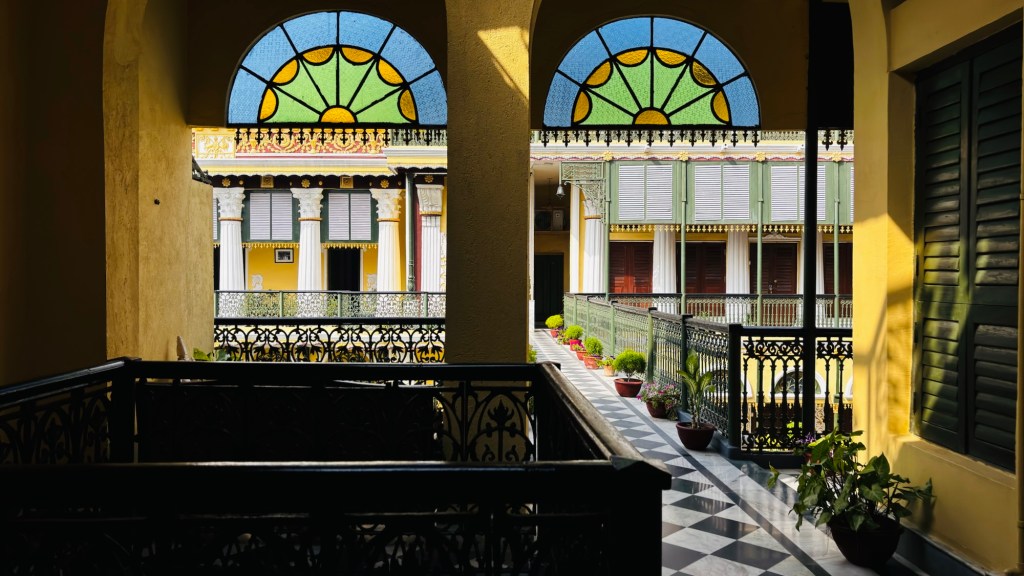
They built palatial mansions along the river — Corinthian pillars, chequered marble floors, stained glass catching the Bengal light — each one a monument to the triumph of trade and commerce. One of these survives in remarkable form. The Dudhorias built Bari Kothi in 1774 , a haveli whose name — the Palace of the Elder — speaks to its place at the top of the family hierarchy.
For nearly half a century it lay abandoned, its grandeur crumbling behind locked gates. From the 1960s, most of Azimganj’s influential families had started shifting to Calcutta. The Naxalite movement dealt the final blow, making it unsafe and compelling the last few families to bow out. By the 1990s, Azimganj was reduced to a desolate address whose looted palaces stood in despair and ruin.
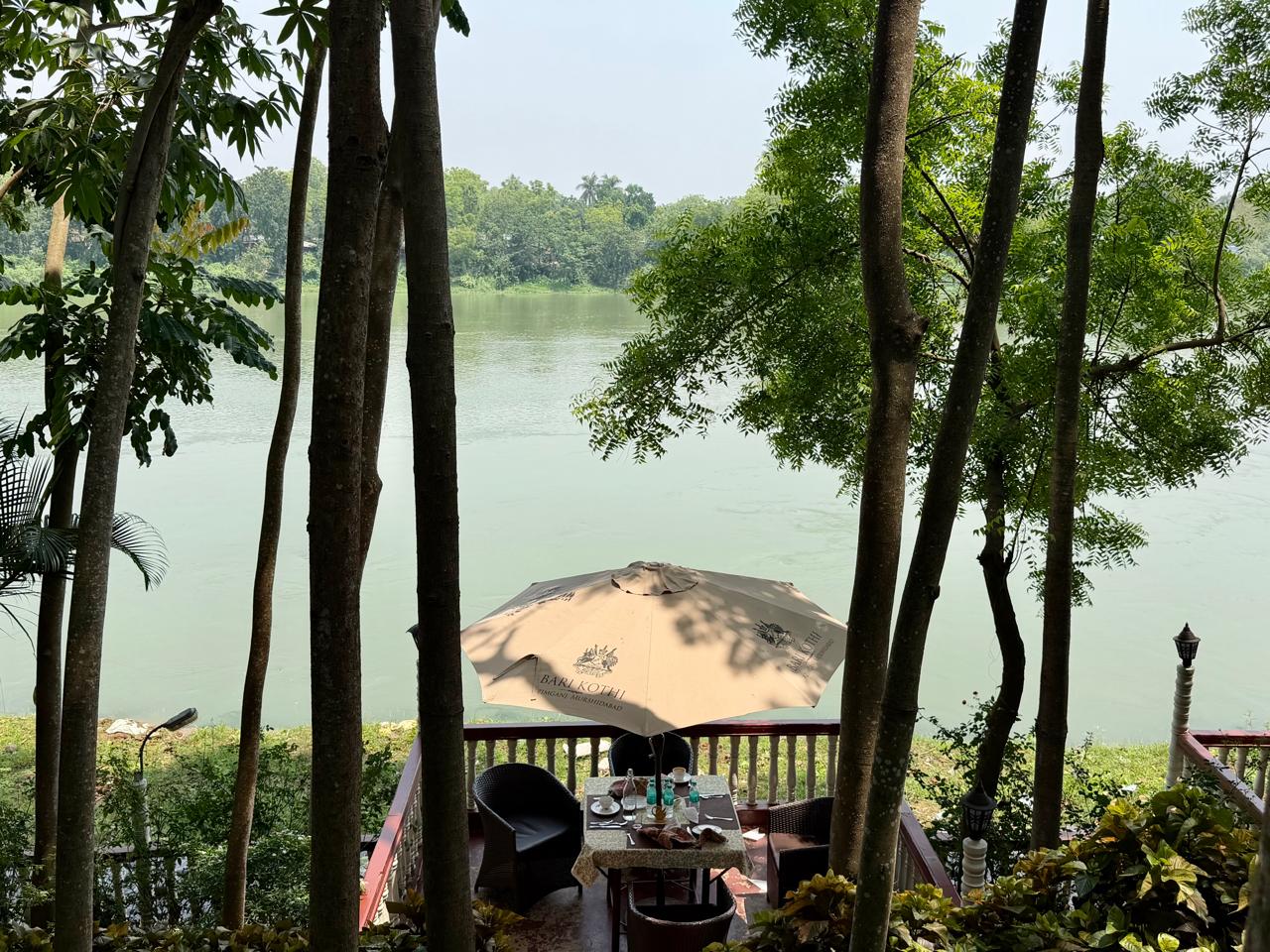
Then, in a story that has something of the fairy tale about it, the brother-sister duo Darshan and Lipika Dudhoria engaged a Canadian restoration specialist to bring Bari Kothi back over five years, turning it into the first grand heritage hotel of east India, entirely managed by the local community. Today it stands on the riverbank in Azimganj — amber walls, antique furnishings, the sound of Baul music drifting across the courtyard at dusk — a small, breathing resurrection in a landscape of dignified decay.
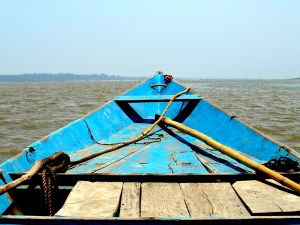
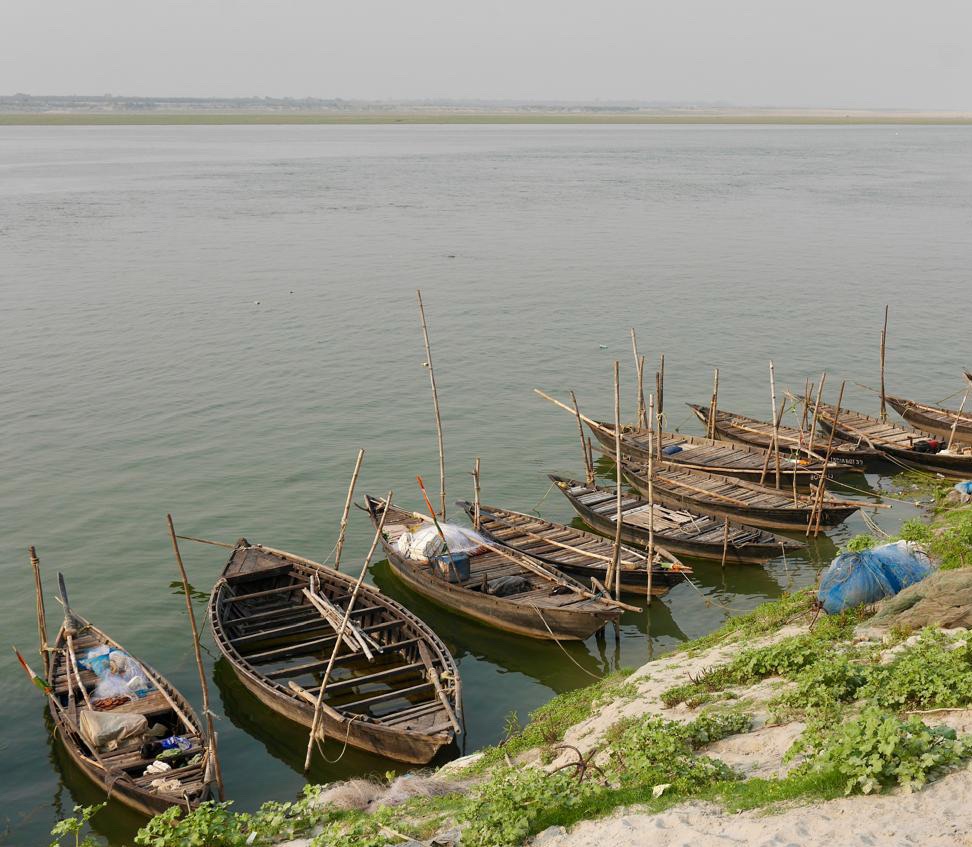
Getting to it, however, requires a strenuous road trip or a river crossing that is itself a journey through time. To cross over to neighbouring Azimganj from Jiaganj, one must wait for a local bamboo raft boat. Of the two varieties that ply the Bhagirathi, one is a passenger boat while the other carries both passengers and vehicles.
Some fellow travellers made it to this extraordinary craft — a broad, flat platform of lashed bamboo and timber, a small engine coughing at the stern, motorcycles and a loaded tempo wedged improbably in the middle, passengers gripping the rails as the current caught them sideways. Travelling in the mornings is particularly difficult, as there are long queues.
During the monsoon, when the Bhagirathi rises and the tides turn fierce, the boat service is suspended by the authorities. Residents are left stranded, hoping for the tides to calm down. There is, apparently, a local legend that explains the absence of a bridge: Goddess Lakshmi, angered by the greed of the Jagat Seths, cursed the Bhagirathi, and this curse is the reason a bridge has still not been built. Whether or not one believes the curse, the bamboo barge has been the only link across this stretch of river for generations.
A Swift Downfall
The downfall of Murshidabad came swiftly, and it was, in the end, a betrayal of almost operatic dimensions. The conspirators who brought down Siraj-ud-Daulah included his commander-in-chief Mir Jafar, his general Rai Durlabh, and the influential Jagat Seths. When Siraj-ud-Daulah demanded a huge tribute from the Seths and reportedly struck them in anger, the family sided with Robert Clive and the East India Company, financing his campaign against the Nawab.
Clive and his army of some 3,000 were outnumbered by the Nawab’s 50,000-strong forces but were victorious because of the defection of Mir Jafar and the political brokering of the Jagat Seths. On 23 June 1757, the Battle of Plassey ended Bengal’s independence forever. The city’s decline began that day.
What the British left behind they left in stone. The grandest monument is the Hazarduari Palace. Based on designs by Colonel Duncan McLeod, the palace was built in the nineteenth-century Neoclassical Italianate style with Doric order influences, by Nawab Nazim Humayun Jah between 1824 and 1838. The grand yellow-coloured structure with Greek Doric columns spreads magnificently on the banks of the Bhagirathi. Its name means “a palace with a thousand doors,” of which one hundred are false — built so that any intruder trying to escape would be confused between the real and fake doors long enough to be caught by the Nawab’s guards. It is a magnificent conceit, and also a useful metaphor for a city full of false exits.
Inside, the museum holds the accumulated grandeur of a broken court: paintings, thrones, chandeliers, armour, Victorian carriages, and a giant stuffed crocodile on the landing. The Hazarduari complex also includes the Nizamat Imambara, the Murshidabad Clock Tower, the Madina Mosque, the Chawk Masjid, and the spectacular Bacchawali Tope — a cannon said to have been fired only once, its sound so thunderous that it reportedly induced labour in pregnant women within a ten-mile radius. Beyond the palace, the Jagat Seth house, the Cossimbazar Palace — where the British once ran their silk factory — and the crumbling Katra Masjid built by Murshid Quli Khan complete a landscape dense with memory.
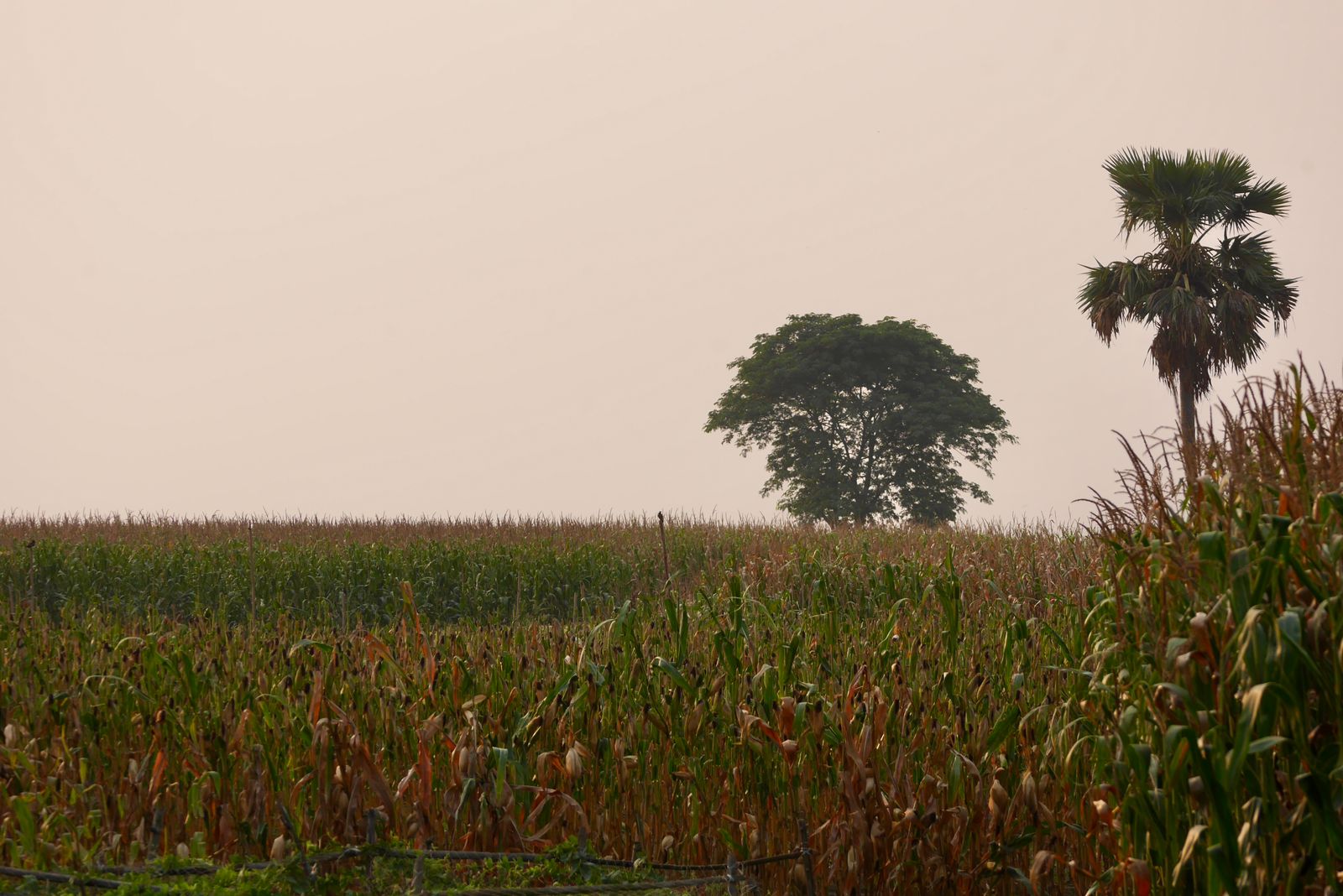
In modern India, Murshidabad is among the most impoverished districts in West Bengal — once the richest city on the subcontinent, now dependent on the beedi industry, silk weaving, and agriculture. Its people are acutely aware of the irony. The weavers produce some of the finest silk in India, yet the looms earn barely enough to live on. The mango orchards along the Bhagirathi produce fruit of extraordinary quality, and the river itself, though diminished, still frames the town in a kind of melancholy beauty — wide skies, flat alluvial plains, and the distant call of the azaan drifting over still water at dusk.
As I walk back toward the Bari Kothi from the edge of the Bhagirathi, I meet an elderly woman sitting on the steps of an decrepit building. She will vote, she says. However, she is not sure it will change anything. Behind her, the building’s wooden doors look out to the river that has carried so much of this history away. Murshidabad taught India what betrayal costs. In 2026, it is still learning whether the lesson was ever truly understood.