Murshidabad : Where History Goes to Vote


In Murshidabad, the Bhagirathi river moves slowly. It always has. Narrower than the Ganga it once was, silted and quieter now, it slides past the great yellow facade of the Hazarduari Palace with the indifference of a river that has seen too much and for too long.

On its far bank, across a short ferry crossing, lies Khushbagh — the Garden of Happiness — where Siraj-ud-Daulah, the last independent Nawab of Bengal, sleeps in a grave surrounded by mango trees. The past and the present press together in Murshidabad with an intimacy you will not find anywhere else in India.

Last week Murshidabad voted in the first round of state polls to elect representatives to the 294-member West Bengal Legislative Assembly, with incumbent Chief Minister Mamata Banerjee seeking a fourth straight term. The second, and final phase of voting will be on Wednesday. Results, along with those from Assam, Kerala, Tamil Nadu and Puducherry, are due on May 4.

The election campaign in Murshidabad felt heavier than elsewhere, charged with a particular dread, as it is one of the most demographically complex districts in India. Its proximity to the Bangladesh border makes it a frequent target of political rhetoric regarding “infiltrators” and national security, creating a polarised environment where the Bharatiya Janata Party (BJP) argues for “purifying” the voter list, while the ruling Trinamool Congress and Congress party characterise the exercise as a threat to legitimate citizens.
Muslims form the majority in Murshidabad district. It is widely believed that they form up to 67% of its population. Across tea stalls on the highway to Kolkata and narrow village lanes, a same story repeated: names deleted, documents demanded, families split between those who can vote and those who cannot.

The district is known for its historically high civic engagement, but this time – after the Special Intensive Revision (SIR) of electoral rolls — voters seem to have turned out in even larger numbers. Yet, the mood into the run-up to polling was not of celebration but suspicion. Central security forces were everywhere — boots on roads that once heard only the shuffle of weavers and the clatter of coin-changers.

The electoral battle in Murshidabad is not just about political ideology but also about economic survival and identity. The district’s “beedi belt” features some of the wealthiest candidates in the state competing for the votes of some of the state’s poorest workers. The TMC holds the ground here, as it has for fifteen years, but the BJP senses possibility.

To understand why this place matters so enormously, you must walk away from the polling booth and toward its palatial mansions left behind by history. During the 18th century, Murshidabad was a prosperous and cosmopolitan town, the capital of Bengal Subah for seventy years. It was home to wealthy banking and merchant families from different parts of the Indian subcontinent and wider Eurasia. The Bengal-Bihar-Orissa triangle was a major production centre for cotton muslin cloth, silk, shipbuilding, gunpowder, and saltpetre. Murshidabad itself was a great centre of silk. European companies — British, French, Dutch, Danish — all conducted business and operated factories around the city, which was also a centre of art and culture. The city’s wealth, by some estimates of the era, exceeded that of London. Murshidabad contributed five per cent of world GDP in the late 1700s and early 1800s.

Jagat Seths and Sheherwalis

Standing at the heart of this was the Jagat Seth family. Their banking empire was often compared to the Bank of England in importance. They managed government funds, collected revenue, and even minted coins. The title Jagat Seth — Banker of the World — was granted by the Mughal Emperor himself. The Nawabs, backed by bankers such as the Jagat Seth, became the financial backbone of the Mughal court, while also serving as financiers to European companies operating in the region. They were not alone.

A community of Rajasthani businessmen who called themselves the “Sheherwalis” — city dwellers — migrated to Murshidabad and worked tirelessly to build empires in textile and banking, becoming zamindars and adapting to the then-prevalent cultural influences of Mughal, British, and European Bengal to create their own unique culture. The Sheherwalis settled in the twin towns of Azimganj and Jiaganj. It is said the combined wealth of 20 to 30 Sheherwali families surpassed that of the entire British aristocracy of the time.

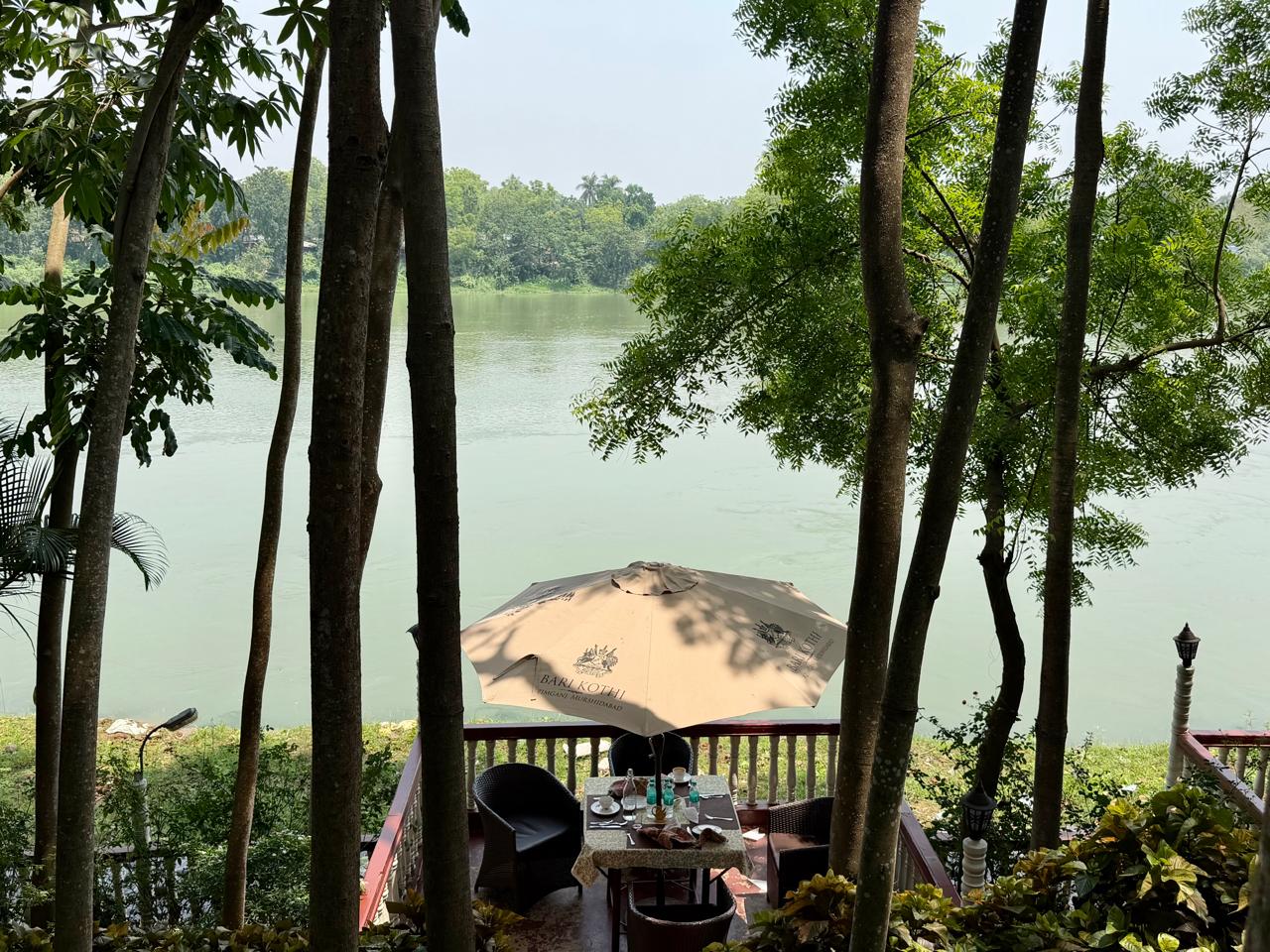
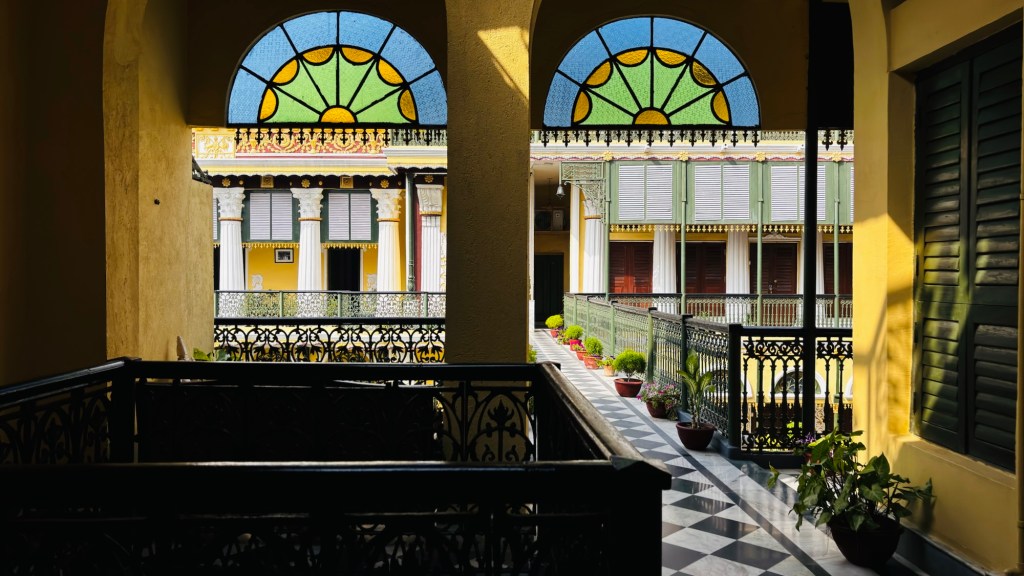
They built palatial mansions along the river — Corinthian pillars, chequered marble floors, stained glass catching the Bengal light — each one a monument to the triumph of trade and commerce. One of these survives in remarkable form. The Dudhorias built Bari Kothi in 1774 , a haveli whose name — the Palace of the Elder — speaks to its place at the top of the family hierarchy.
For nearly half a century it lay abandoned, its grandeur crumbling behind locked gates. From the 1960s, most of Azimganj’s influential families had started shifting to Calcutta. The Naxalite movement dealt the final blow, making it unsafe and compelling the last few families to bow out. By the 1990s, Azimganj was reduced to a desolate address whose looted palaces stood in despair and ruin.

Then, in a story that has something of the fairy tale about it, the brother-sister duo Darshan and Lipika Dudhoria engaged a Canadian restoration specialist to bring Bari Kothi back over five years, turning it into the first grand heritage hotel of east India, entirely managed by the local community. Today it stands on the riverbank in Azimganj — amber walls, antique furnishings, the sound of Baul music drifting across the courtyard at dusk — a small, breathing resurrection in a landscape of dignified decay.

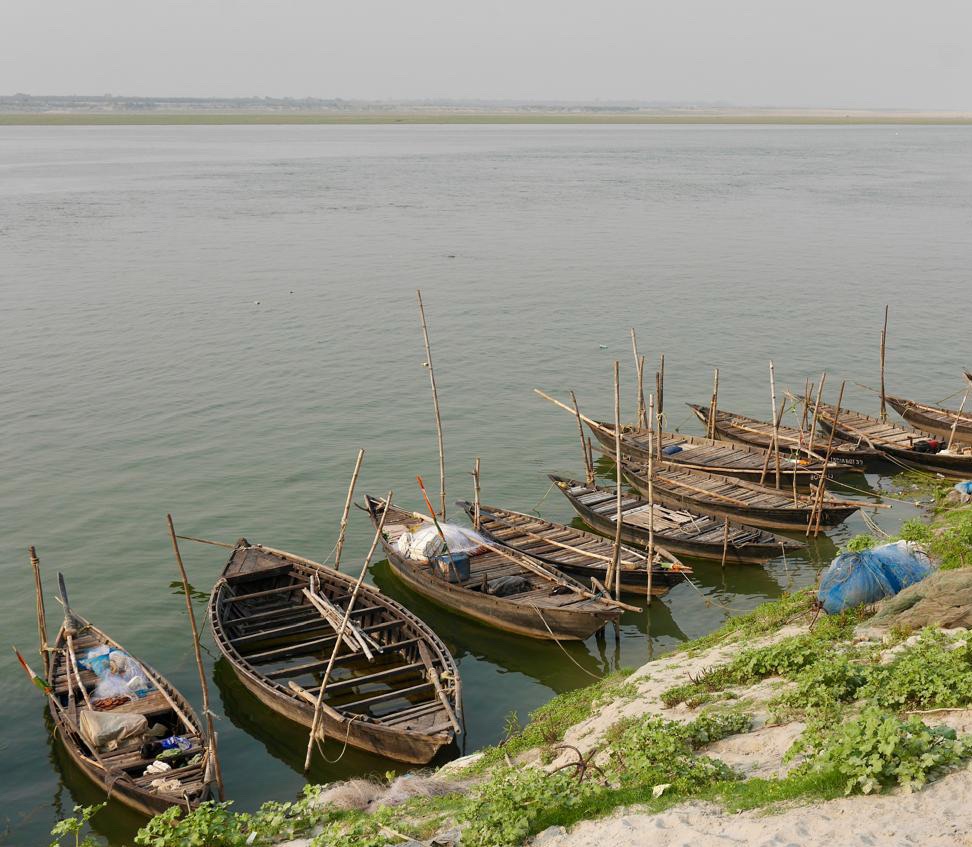
Getting to it, however, requires a strenuous road trip or a river crossing that is itself a journey through time. To cross over to neighbouring Azimganj from Jiaganj, one must wait for a local bamboo raft boat. Of the two varieties that ply the Bhagirathi, one is a passenger boat while the other carries both passengers and vehicles.
Some fellow travellers made it to this extraordinary craft — a broad, flat platform of lashed bamboo and timber, a small engine coughing at the stern, motorcycles and a loaded tempo wedged improbably in the middle, passengers gripping the rails as the current caught them sideways. Travelling in the mornings is particularly difficult, as there are long queues.

During the monsoon, when the Bhagirathi rises and the tides turn fierce, the boat service is suspended by the authorities. Residents are left stranded, hoping for the tides to calm down. There is, apparently, a local legend that explains the absence of a bridge: Goddess Lakshmi, angered by the greed of the Jagat Seths, cursed the Bhagirathi, and this curse is the reason a bridge has still not been built. Whether or not one believes the curse, the bamboo barge has been the only link across this stretch of river for generations.

A Swift Downfall

The downfall of Murshidabad came swiftly, and it was, in the end, a betrayal of almost operatic dimensions. The conspirators who brought down Siraj-ud-Daulah included his commander-in-chief Mir Jafar, his general Rai Durlabh, and the influential Jagat Seths. When Siraj-ud-Daulah demanded a huge tribute from the Seths and reportedly struck them in anger, the family sided with Robert Clive and the East India Company, financing his campaign against the Nawab.

Clive and his army of some 3,000 were outnumbered by the Nawab’s 50,000-strong forces but were victorious because of the defection of Mir Jafar and the political brokering of the Jagat Seths. On 23 June 1757, the Battle of Plassey ended Bengal’s independence forever. The city’s decline began that day.

What the British left behind they left in stone. The grandest monument is the Hazarduari Palace. Based on designs by Colonel Duncan McLeod, the palace was built in the nineteenth-century Neoclassical Italianate style with Doric order influences, by Nawab Nazim Humayun Jah between 1824 and 1838. The grand yellow-coloured structure with Greek Doric columns spreads magnificently on the banks of the Bhagirathi. Its name means “a palace with a thousand doors,” of which one hundred are false — built so that any intruder trying to escape would be confused between the real and fake doors long enough to be caught by the Nawab’s guards. It is a magnificent conceit, and also a useful metaphor for a city full of false exits.
Inside, the museum holds the accumulated grandeur of a broken court: paintings, thrones, chandeliers, armour, Victorian carriages, and a giant stuffed crocodile on the landing. The Hazarduari complex also includes the Nizamat Imambara, the Murshidabad Clock Tower, the Madina Mosque, the Chawk Masjid, and the spectacular Bacchawali Tope — a cannon said to have been fired only once, its sound so thunderous that it reportedly induced labour in pregnant women within a ten-mile radius. Beyond the palace, the Jagat Seth house, the Cossimbazar Palace — where the British once ran their silk factory — and the crumbling Katra Masjid built by Murshid Quli Khan complete a landscape dense with memory.

In modern India, Murshidabad is among the most impoverished districts in West Bengal — once the richest city on the subcontinent, now dependent on the beedi industry, silk weaving, and agriculture. Its people are acutely aware of the irony. The weavers produce some of the finest silk in India, yet the looms earn barely enough to live on. The mango orchards along the Bhagirathi produce fruit of extraordinary quality, and the river itself, though diminished, still frames the town in a kind of melancholy beauty — wide skies, flat alluvial plains, and the distant call of the azaan drifting over still water at dusk.

As I walk back toward the Bari Kothi from the edge of the Bhagirathi, I meet an elderly woman sitting on the steps of an decrepit building. She will vote, she says. However, she is not sure it will change anything. Behind her, the building’s wooden doors look out to the river that has carried so much of this history away. Murshidabad taught India what betrayal costs. In 2026, it is still learning whether the lesson was ever truly understood.

Donald Trump And His Known Knowns


People all around seem rather agitated with the start of a new regime in the United States. And yes, I am using the word regime, which the Western media usually uses for rogue and unpredictable governments for only one reason: the new administration in Washington is unpredictable and can indeed go rogue, or so some Americans would want you to believe.

Donald Trump, the new president, has ignited passions in a manner unseen in recent memory – upsetting not only hordes of Americans, but also intelligent folks around the world who seem to widely believe that he might be the ultimate disaster to hit all of us.

However, it is not the end of the world, Not yet.

Let’s be fair to Trump and the process of democracy that brought him to power. Those who are complaining are Americans who either did not vote for him or many like us who are citizens of other countries and, therefore, ineligible to vote in U.S. elections. Both these constituencies have no reason to crib, so let’s hear what Trump is saying. There is a fair chance that if he is making sense to some, he might start making sense to all.

Lets also understand that Trump, who has never held a government office or been in military, will click very differently than many of his predecessors who were active in politics or military before they assumed the high office.

Since Trump is essentially a businessman, an unabashed profiteer and a salesman (who has done well to create his own brand across many countries), for him world affairs, global diplomacy and international trade will always be about negotiations and deals – both of which he is good at.

Should we complain about a man – whatever his past may be (and Trump’s not exactly without in-your-face blemishes) – just because he is different from his predecessors and doesn’t conform to our “global” definition of a politician or a president?

Eventually what matters to Trump and those who voted for him is whether he delivers what he promised to. There is no problem with his “America First” for Americans. If the rest of the world has a problem with it, it is not Trump’s problem and the 45th U.S. president seems to know it well – at least for the time being.

China, Europe and even Indian IT companies can fret because Trump’s policies can hit their businesses in the United States; for Trump what matters is looking after his country’s interests – whether they be jobs, infrastructure or Islamic radicals. As president of his country he is first answerable to and responsible for the people of his country. In short, national interest will drive him just as it did his predecessors.

We may not appreciate his front-foot statements and awful tweets, his name-calling and his orange hair or even lack of political and diplomatic etiquettes. What, however, we do need to remember is the world will have to deal with President Trump at least for the next four years.

Governments and businesses will have to, therefore, quickly learn to deal with his idiosyncrasies, his unpredictability, his awful spokespeople, his son-in-law who Trump says will resolve the issues in the Middle East and his purported closeness to Russia and its president Vladimir Putin. Americans will also have to deal with a man who doesn’t’ fit the role; the very reason he got elected and one who will do everything to undo whatever his predecessor Barack Obama did.

In the weeks and months ahead all of us have to get used to a new narrative from Washington. We have to get used to dealing with a penny-pinching, hard-bargaining businessman who will keep his interests (or should we say America’s interests) high on his list of things to do.

And that brings me to what former U.S. Defense Secretary Donald Rumsfeld’s once-considered-gobbledygook theory of the known knowns, the known unknowns and the unknown unknowns. I’d put Trump in the first category. We do know him, and we also know what he will do — not very different than what he has been saying he would. What we still don’t probably have the foggiest idea about is that whether he is going to be around for four years or eight.

Good luck, everybody!

RS


It’s The Jobs, Stupid


By Rahul Sharma

Caravan Daily

There is a very good reason why Narendra Modi speaks to India’s young and exhorts them to vote the current Congress-led government out. He understands the simmering discontent among the country’s massive young population that is out looking for jobs and not finding any unlike other politicians who still believe only in politics of dole, caste and religion.

The state of the young in India is dismal and the mood gray. A slowing economy and high cost of living have only added to their woes. Add to that the fact that business sentiment will continue to be poor for the next several months in the run up to the elections – and even after that if a sustainable government doesn’t come to power – and you see a horribly potent recipe for social unrest.

Modi knows that if the young – a brand new, vibrant constituency — start believing that he will get those jobs and the financial sustainability that would let them buy all the gadgets, goods, automobiles and apartments, they would come out in throngs and help him win next year’s general elections.

Given the state of India’s shrinking job market into which 12 million youth trundle in every year, Modi’s call resonates well not only in large urban centres, but also the smaller towns where aspirations and opportunities have made traditional roles redundant.

So how badly off is the situation?

If you believe a new Confederation of Indian Industries-Economic Times (CII-ET) survey of India’s young, it’s pretty nasty out there. Of its 1.2 billion people, 800 million are less than 35 years old – and they seem to be really upset with the way things are.

According to the survey, findings of which were published in The Economic Times, three out of four of them believe that the economy today is worse off than it was in the aftermath of the 2008 global financial crises. More than half say it is the worst time to look for jobs and nearly 60 percent have postponed buying a house, a car or having children. Worse, nearly 40 percent of the people polled in 28 cities said they won’t mind taking a pay cut if that improves their chances of holding on to a job.

It can’t get worse for the Congress; and it can’t be better for Modi and his Bharatiya Janata Party (BJP), which is still looking for that one issue that could change its fate and bring it out of its decade-long political wilderness.

“This is the most disturbing micro impact of the macro slowdown,” the newspaper quoted Rajya Sabha MP and entrepreneur Rajeev Chandrashekkhar as saying. According to him, educated Indians looking for their first or second jobs are hurting the most.

Thousands of engineering, medicine and businesses schools in India produce millions of graduates each year. But they hit a hard wall when they get into the job market. The impact is two pronged. Fewer jobs also mean there aren’t many takers for the seats in the graduate and post-graduate schools, many of which are beginning to shut down.

“The following set of numbers shows the young have read the grim job market right. Andhra Pradesh has over 700 engineering colleges and 350,000 seats – the highest in any Indian state. But just 200,000 seats were filled up this year. Why? Because just 20% of the class of 2013 have got jobs. When young Indians give up the chance of getting an engineering degree, you know there’s something very wrong,” the Economic Times wrote.

The other, bigger, impact is on the consumer, automobile and real estate markets, which are now losing their sheen as poor demand pulls the economy down. No wonder, the government is being forced to ask state-owned banks to offer cheaper loans for consumer goods and two-wheelers to boost demand in an otherwise depressing economy.
These are problems only politicians can address. There is a need for a fresh thinking and new policies that could create more jobs, both in the manufacturing and services sector. There is a need to lift business sentiment so that investments on hold can be channeled into infrastructure and other industries that would create jobs. These are issues that can’t be solved overnight, but if you have a large chunk of your population that is either unemployed or underemployed, you have a huge problem on hand.

If you believe Modi, then he probably understands the issues better than other politicians. The Congress doesn’t seem to have a solution, nor can it explain its lethargy in fixing the situation in the 10 years that it has ruled India. The grand old party is not even talking about jobs – at least not yet. A disgruntled youth is not good for politicians and the country. The leader who can show a way to the youth stuck in between a rock and hard place is likely to win the next election.

It is up to politicians and the next government to take the right steps.

Modi Leads The Charge For Now


By Rahul Sharma

PRMoment

More than two years ago a taxi driver in Kerala told me that he would vote for Narendra Modi if he ever got an opportunity. A year later – and this was before Modi won the Gujarat state elections for the third time – a hotel doorman in Chennai said the same thing. And earlier this year a young engineer working with a technology company in Bangalore echoed similar sentiments.

In the two years since the Kerala cabbie voiced his support for Modi, the perception that the Gujarat chief minister (and yes, he continues to be in that role) is a strong administrator, decisive, incorruptible and a man who keeps his promises has only strengthened. In New Delhi, in Kolkata, in Lucknow, Bhopal, Jaipur and Mumbai, Modi looks down upon us from posters and billboards – half smiling, half mocking, challenging everybody – especially the Congress that seems to merely follow his political agenda.

Never has an Indian politician been “branded” as Modi has been. We have NaMo phones, we have NaMo tea stalls, there are already two biographies out in the book stores and a biopic is underway. We also have a NaMo kurta, and probably many other products to come as the election temperatures rise.

Pitched as Bharatiya Janata Party’s (BJP) potential prime ministerial candidate after the 2014 elections, Modi is setting himself up against a much younger, yet non-branded, Rahul Gandhi – the scion of a political family that has either ruled or helped rule India for a very long time. A perception battle between the two – amplified by the media – is probably the most top-of-the-mind dinner table discussion these days and one that Modi seems to be winning, at least for now.

As Modi launches his political blitzkrieg, mowing miles with his first-mover advantage, it is amply clear that he is working to a sharply targeted multimedia strategy put together by a war room that is propping him as a leader who can change India. The early start bodes well as it will give Modi and his team enough time to convert the fence sitters and break away those charmed by the Congress.

The media is helping by headlining every word Modi utters and television panel discussions are only cementing his position as a man who matters. Slowly, but surely, Modi’s image of a steely leader is getting entrenched into the political and social frequency of an election that is still some months away.

On the other hand, Gandhi seems weak, indecisive, and battling his own party, as he tells people his mother was upset with his choice of words when he interrupted a party press conference to oppose a proposed ordinance allowing convicted parliamentarians to keep their seats that was cleared by the prime minister and his cabinet.

Set up against a wily politician and an orator who can transfix the crowds, Gandhi’s image of a reluctant inheritor only gets a fresh shine every time he speaks.

The battle is between a man who thinks on his feet and seemingly wants to lead this large and diverse country, and another who still doesn’t seem to have made up his mind about whether he wants the job. In the public relations battle, Modi has won the first set. He’s still got to win the match though.

The shift in perception since the days when the national media called Modi a “murderer” after the deadly 2002 religious riots in Gujarat has been slow but huge.

No longer is Modi the pariah he once was. No longer is he hated or reviled as he was. No longer is he a political embarrassment (to many) as he was. No longer is he in the headlines for the “wrong” reasons as he was. Feted by the industry, the youth seeking jobs and a middle class frustrated with the Congress government over poor governance, dynastic politics and inflation, Modi seems to have grabbed people’s imagination and emotions.

Gandhi is sincere, but he lacks the power to hold the crowds and veer them to see his point of view. That’s because while Modi is all over, Gandhi pops in and out with statements that only raise more questions. New Delhi’s political citizenry is widely convinced that the young man wants Congress to lose badly so that he could then clean up the grand old party’s corrupt, wobbly script.

I remember watching Modi make the crowds dance during his election rallies in his home state back in 2007. Thousands of people wearing the “Modi Mask” followed the slow wave of the man’s hand from left to right – hypnotized by the sheer power of his oratory and stage theatrics. It scared many a political pundit. Gandhi is no match. In fact, the entire Congress party is made of weak speakers who sound unconvincing even when they mean business.

But let’s remember that a few months is a long time in politics and a lot could happen between now and the elections due by May next year. Winning a public relations and a perception skirmish is only part of the larger battle that Modi has to fight to help the BJP return to power after a decade in the wilderness. Voters might love Modi, but they might still choose not to cast their ballot for his party.

Eventually, Modi will have to make people believe that he is not as divisive as many believe him to be if he wants the top job. That’s easier said than done. The posters and potshots are fine for now. The winner in the public relations battle between Modi and Gandhi will only be announced next year – the day the votes are counted. Until then, watch the political theatre and enjoy.