Every empire leaves something behind. The Romans left roads, the Mughals left gardens, and the British left a towel.
It arrived as a modest piece of hygiene. The British once ran a quarter of the planet from offices where the leather chairs were expensive and the climate was a personal insult, and some forgotten official concluded that the true enemy of empire was perspiration.
A white towel was laid across the back of the chair and two smaller ones on the arms. The empire, in a sense, was saved by terry cloth, and it went on to lose everything else.
What is remarkable is how much of the apparatus India has since dismantled, renamed, amended or sent for review. Roads have new names. Railway stations have new names. Cities too have new names. Statutes have been rewritten, committees convened, commissions commissioned. The towel has been through none of it.
No parliamentary panel has probably asked what it is for — the last colonial institution in the country with a perfect record of uninterrupted service — and it has never once been asked to justify its budget, mainly because nobody can probably say which budget it is in.
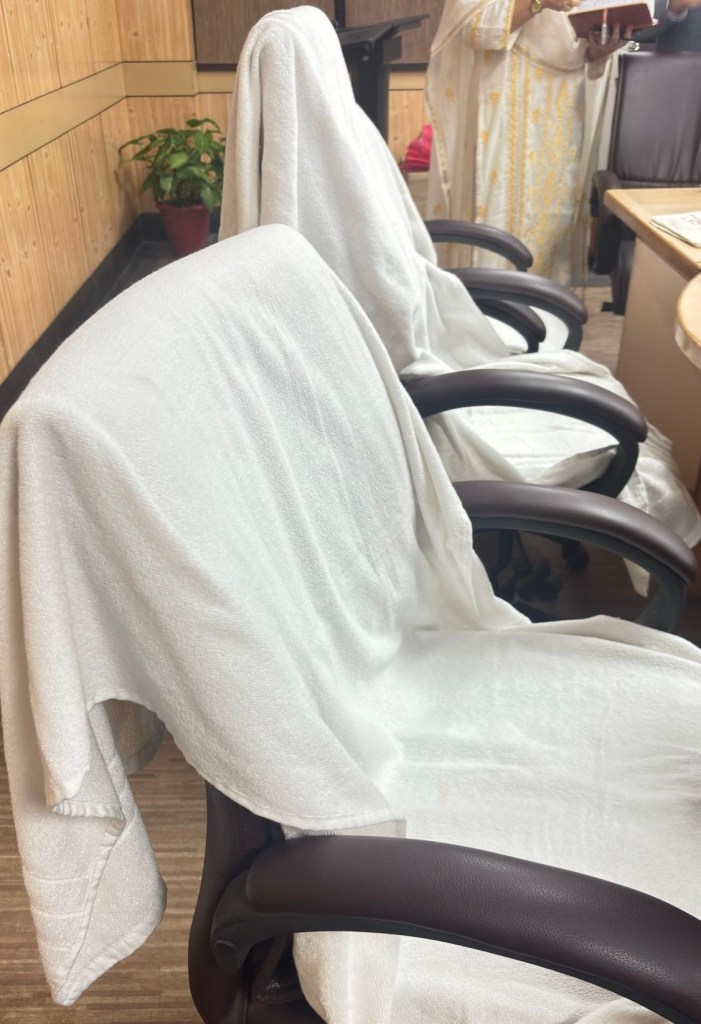
Air conditioning, you would think, should have ended the argument. The room is now a refrigerated 22 degrees, the officer does not sweat, and the chair has nothing to be protected from. But a symbol is the one thing in government that outlives its purpose and then thrives on the loss. The towel may no longer absorbs sweat, but it absorbs deference, which is far more plentiful in the building and far harder to launder.
Consider its rivals. Red ink for the senior, blue for the junior, and a third colour that no one has ever been able to explain, which is perhaps the point. A desk measured to the inch. The red telephone, which rings rarely, as befits an instrument of state that has outgrown conversation. Among these the towel is the quiet one, the one that does not need to be loud because it is white, and nothing else in the office is.
Someone must wash it, of course. This is the real mystery. A peon of unspecified grade, appearing in no sanctioned post, performs a daily act of textile devotion that the Seventh Pay Commission did not foresee and the Right to Information Act could not locate. Should he fall ill, the office would discover for the first time how much of its authority had been resting on his ironing.
Where there is a towel, there is grievance too. A legislator, elected by lakhs of voters, entered an office to discover that the chair offered to him bore no towel. He had won a mandate and been handed a bare seat. It was explained to him, gently, that the towel was a matter of protocol, and that protocol is the polite word for the thing that governs a room once the voters have gone home. The matter climbed. Circulars were drafted.
Somewhere a secretary, a man who had spent thirty years learning never to commit anything to paper, committed to paper the following sentence, or something very like it: that seating arrangements for visiting representatives of the people shall be of comparable dignity.
Comparable. Not equal. The language of the republic, pressed into service one more time, found the one word that let everyone keep their towel.
There is a lesson here about power, though it is not the one the towel teaches. The towel says that authority is something you drape over a chair and that the chair, thus dressed, does the rest. The visitor who finds himself on the lower seat looks across the desk at a person he has never met, and knows his place before a word is spoken. The occupant, meanwhile, rises at five o’clock, gathers his files, and walks out into a city where nobody has draped anything over him at all.
The towel stays. It is warm for a moment, from an authority that has just left, and cool again by morning, ready for the next one. If you lifted it, you would find only an ordinary chair. That is the one thing nobody in the building is willing to discover.

